



Agile vs Waterfall: Cost, Timeline, and Risk Comparison
Choosing the right software development methodology can define the success or failure of a digital product. Businesses today often find themselves weighing Agile vs Waterfall while planning mobile or web applications. Each approach has its strengths, limitations, and ideal use cases. Understanding how these models compare in terms of cost, timeline, and risk management helps decision-makers choose wisely and align development with business goals.
As an experienced app development company in Mumbai, Appdid works closely with startups and enterprises to select the most effective development approach for Android, iOS, and cross-platform applications. This in-depth guide explores Agile and Waterfall from an expert perspective, using industry-relevant insights and SEO-friendly terminology to help you make an informed decision.
Understanding Software Development Methodologies
Software development methodologies provide structured frameworks that guide how applications are planned, built, tested, and delivered. The two most widely discussed models are Agile development and the Waterfall model. While both aim to deliver functional, high-quality software, their philosophies and execution differ significantly.
Choosing between Agile and Waterfall depends on factors such as project complexity, budget flexibility, client involvement, and risk tolerance. Let’s explore each methodology in detail before comparing them across cost, timeline, and risk.
What Is the Waterfall Model?
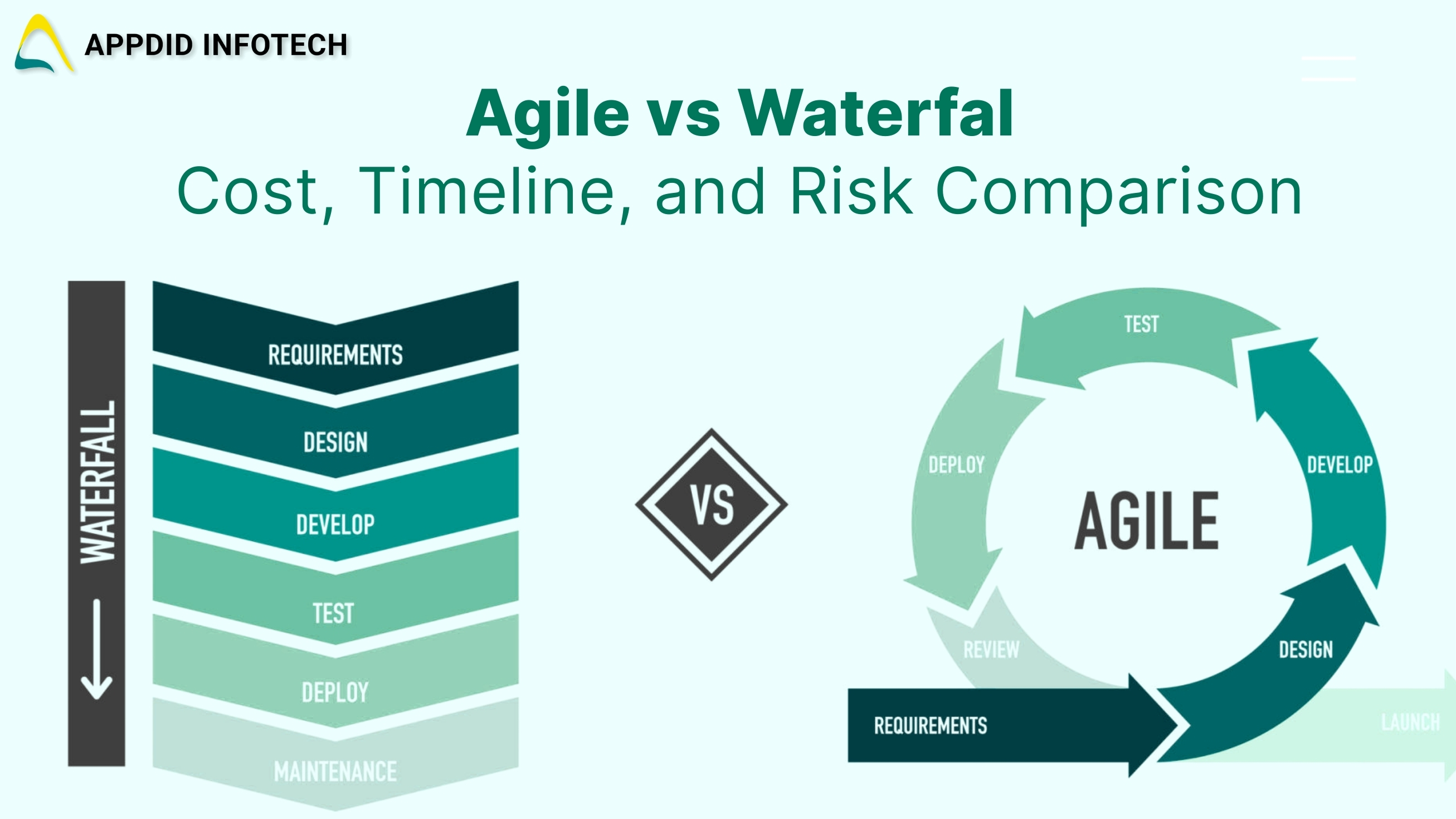
The Waterfall model is a traditional software development approach based on a linear and sequential process. Development flows in one direction, similar to a cascading waterfall, where each phase must be completed before the next begins.
Key Characteristics of Waterfall Development
-
Emphasizes upfront planning and structured approach
-
Relies on detailed documentation throughout the project
-
Requirements are clearly defined at the beginning
-
Changes are discouraged once development progresses
-
Follows a sequential phase-based workflow: requirement analysis → system design → development → testing → deployment → maintenance
-
Best suited for projects with stable requirements
-
Ideal for projects with predictable outcomes
-
Requires minimal ongoing client feedback during development
What Is Agile Development?
Agile development is a flexible, iterative approach that focuses on collaboration, adaptability, and continuous improvement. Instead of delivering the entire product at once, Agile teams work in short development cycles, releasing functional components regularly.
Key Characteristics of Agile Methodology
-
Strong focus on customer collaboration throughout the development process
-
Encourages frequent testing to identify and fix issues early
-
Supports a rapid response to change, even in later stages of development
-
Requirements are flexible and evolve as the project progresses
-
Continuous incorporation of user feedback to improve product quality
-
Adaptable to changing market conditions and business needs
-
Enables iterative development, delivering features in small, usable increments
-
Highly suitable for mobile app development, where technology and user expectations shift quickly.
Agile vs Waterfall: Cost Comparison
Cost is one of the most critical factors when choosing a development methodology. Agile and Waterfall differ significantly in how expenses are planned, managed, and optimized.
Cost Structure in Waterfall Projects
In the Waterfall model, costs are usually estimated early in the project lifecycle. Since requirements are fixed upfront, budgeting is more predictable. This can be beneficial for organizations with strict financial planning processes.
However, this predictability comes with a trade-off. If changes are required later, they can be expensive to implement because the project may need to revisit completed phases. Unexpected revisions can increase development effort and overall expenditure.
Cost Structure in Agile Projects
Agile development offers more flexibility in cost management. Instead of a fixed scope, costs are distributed across iterative cycles. This allows businesses to prioritize features that deliver the highest value and adjust spending as the project evolves.
While Agile may appear less predictable at first, it often results in better cost efficiency in the long term. By identifying issues early and incorporating user feedback continuously, Agile reduces the likelihood of costly rework after deployment.
Agile vs Waterfall: Timeline Comparison
Project timelines play a vital role in determining time-to-market and competitive advantage. Agile and Waterfall approaches manage timelines very differently.
Project timelines play a vital role in determining time-to-market and competitive advantage. Agile and Waterfall approaches manage timelines very differently.
Timeline in Waterfall Development
Waterfall projects follow a predefined schedule, with each phase dependent on the completion of the previous one. This makes timelines easier to plan initially, especially for well-defined projects.
However, delays in any phase can impact the entire schedule. Since testing occurs later in the process, issues discovered toward the end can significantly extend delivery timelines.
Timeline in Agile Development
Agile development emphasizes incremental delivery. Instead of waiting for the entire product to be completed, functional features are released regularly. This allows businesses to launch sooner and gather real-world feedback.
Agile timelines are adaptive rather than rigid. While the overall project duration may evolve, stakeholders gain visibility into progress at every stage. This iterative approach often results in faster deployment of core features and quicker market entry.
Agile vs Waterfall: Risk Comparison
Risk management is where the contrast between Agile and Waterfall becomes most apparent. Each methodology addresses uncertainty in a distinct way.
Risk Factors in Waterfall Projects
The Waterfall model carries higher risk when requirements are unclear or likely to change. Since feedback is collected late in the process, misunderstandings or incorrect assumptions may only surface during testing or after launch.
This can lead to significant rework, increased costs, and delays. Waterfall also poses a higher risk of delivering a product that no longer aligns with market needs by the time it is released.
Risk Factors in Agile Projects
Agile reduces risk through continuous testing, frequent releases, and ongoing stakeholder involvement. Issues are identified early, making them easier and less costly to fix.
Because Agile welcomes change, it adapts well to evolving business requirements and user expectations. This proactive approach to risk management makes Agile especially suitable for mobile app development and digital products in fast-moving industries.
Agile vs Waterfall in Mobile App Development
When it comes to Android, iOS, and cross-platform app development, Agile methodology is often the preferred choice. Mobile apps require frequent updates, user-centric design, and rapid adaptation to platform changes.
Waterfall may still be effective for internal systems or applications with fixed functionality. However, for customer-facing apps where user feedback drives success, Agile provides the flexibility and responsiveness needed to stay competitive.
At Appdid, we often recommend Agile development for mobile applications because it allows our clients to validate ideas quickly, optimize features, and scale efficiently.
Choosing the Right Methodology for Your Business
Selecting between Agile and Waterfall depends on your project goals, organizational culture, and technical requirements. Businesses with clear, stable requirements and limited need for change may benefit from Waterfall’s structured approach.
On the other hand, companies seeking innovation, faster time-to-market, and continuous improvement often find Agile to be the better fit. Hybrid approaches are also possible, combining elements of both methodologies to suit specific project needs.
Frequently Asked Questions
Which development methodology is better for startups?
Agile development is generally better suited for startups because it supports rapid iteration, user feedback, and evolving business models. Startups benefit from Agile’s flexibility and ability to adapt quickly to market demands.
Is Waterfall completely outdated?
Waterfall is not outdated but is best used in scenarios where requirements are well-defined and unlikely to change. Certain industries and compliance-driven projects still rely on Waterfall for its structured documentation and predictability.
Can Agile and Waterfall be combined?
Yes, many organizations use a hybrid approach that blends Agile and Waterfall principles. This allows teams to maintain structure while benefiting from flexibility in development and testing phases.
How does client involvement differ between Agile and Waterfall?
Agile requires continuous client involvement throughout the project, while Waterfall typically involves clients mainly during the requirement and delivery stages. Higher collaboration in Agile leads to better alignment with business goals.
Which methodology reduces project failure risk?
Agile generally reduces project failure risk by addressing issues early, incorporating feedback regularly, and adapting to change. Waterfall carries higher risk when project assumptions change over time.
Final Thoughts from Appdid
Understanding the differences between Agile and Waterfall is essential for making strategic development decisions. Cost efficiency, realistic timelines, and effective risk management depend heavily on choosing the right methodology for your project.
At Appdid, we specialize in Android, iOS, and cross-platform app development, delivering scalable and user-focused solutions tailored to business needs. As a trusted app development company in Thane and Mumbai, we help businesses navigate methodology choices and build high-performing applications that drive growth.
If you are looking for a reliable partner to transform your app idea into a successful digital product, Appdid is here to help. Let’s build innovative, future-ready applications together. Contact Appdid today!