Mobile Backend as a Service in Mumbai: MBaaS Guide
Mobile Backend as a Service in Mumbai: How MBaaS Simplifies App Development
Developing a mobile application involves more than designing screens and implementing user-facing features. Every application also requires backend infrastructure to manage user accounts, store information, process requests, handle authentication and support communication between different systems. For businesses exploring mobile app development in Mumbai, mobile backend as a service (MBaaS) offers an approach to managing these backend requirements through ready-to-use cloud-based services. Businesses can explore Appdid's mobile backend as a service solution to understand how backend functionality can support mobile application development.
Traditional backend development often requires developers to build and maintain infrastructure, databases, APIs and authentication systems. An MBaaS platform provides selected backend capabilities through managed services and SDKs, helping development teams integrate common functionality into applications. This can be useful for businesses that need features such as user management, cloud databases, push notifications and data synchronization.
For organizations planning custom applications, selecting the right backend approach is an important technical decision. Along with mobile app development services in Mumbai, businesses should evaluate how backend infrastructure, API integration and application architecture will support their requirements.
This guide explains what mobile backend as a service is, how it works, its essential features, benefits, limitations and how businesses in Mumbai can evaluate an MBaaS solution.
What Is Mobile Backend as a Service (MBaaS)?
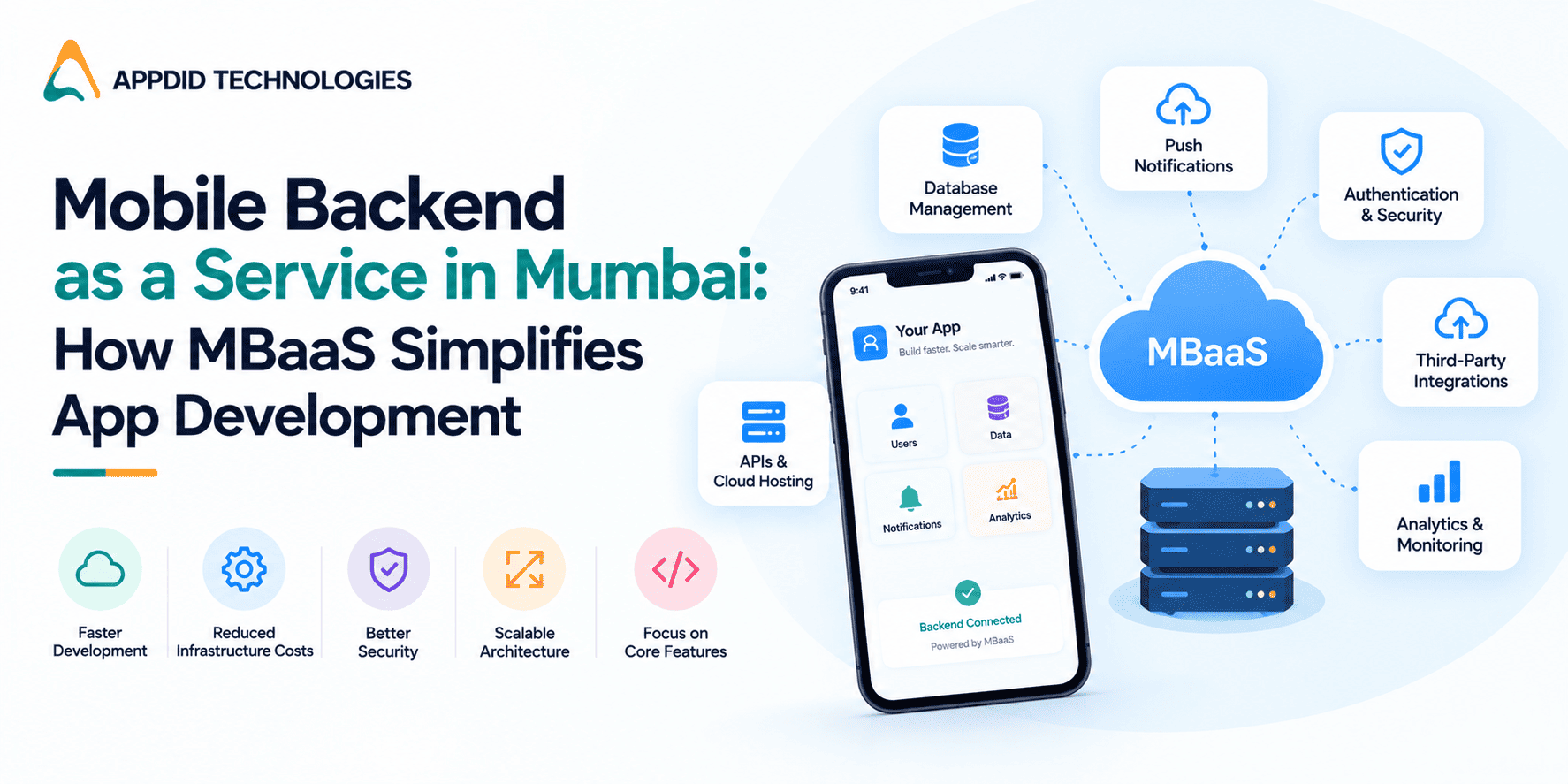
Mobile Backend as a Service, commonly known as MBaaS, is a cloud-based approach that provides backend functionality for mobile applications through managed services, APIs and software development kits.
Instead of developing every backend component from scratch, developers can use available backend services for common requirements such as:
-
User registration and authentication
-
Cloud database management
-
File and media storage
-
Push notifications
-
API connectivity
-
Data synchronization
-
User management
-
Application analytics, where supported
These services allow mobile applications to communicate with backend infrastructure without requiring every component to be independently developed and maintained.
For example, consider a business building a customer-facing mobile application. The application may need user registration, profile management, notifications and cloud-based data storage. An MBaaS platform can provide selected backend capabilities that developers integrate into the application.
The exact services available depend on the MBaaS provider, its pricing plan, technical architecture and supported SDKs.
How Does an MBaaS Platform Work?
An MBaaS platform acts as a backend service layer between the mobile application and its data or supporting infrastructure.
A typical architecture includes three main components.
1. Mobile Application Frontend
The frontend is the part of the application that users interact with.
It includes screens, buttons, forms, navigation and other interface elements. When users register, log in, submit information or request data, the application sends requests to the backend.
2. MBaaS Backend Services
The MBaaS platform provides selected backend capabilities through APIs and SDKs.
Depending on the provider, these services may include authentication, databases, storage, notifications and other application functionality.
Developers integrate the required services into the application rather than implementing every backend component independently.
3. Cloud Infrastructure and Data Storage
The cloud infrastructure stores application information and processes backend requests.
It may support user records, application data, uploaded files and other information required by the application.
A simplified example:
-
A user opens a mobile application.
-
The user enters login credentials.
-
The application sends an authentication request.
-
The backend service validates the request.
-
The application receives the appropriate response.
-
The user accesses the permitted application features.
The architecture and security controls depend on the selected platform and the way the application is implemented.
Essential Features of a Mobile Backend as a Service Platform
When evaluating an MBaaS platform, businesses should understand which backend features are available and whether they meet the application's requirements.
1. User Authentication and Management
Authentication allows applications to identify users and control access to their accounts.
Depending on the platform, authentication functionality may include:
-
User registration
-
Login and logout
-
Password management
-
Email verification
-
Social login integrations
-
Session management
-
User access controls
For applications with multiple user categories, such as customers, administrators and service providers, the backend may also need role-based permissions.
Security requirements should be reviewed carefully before integrating authentication services.
2. Cloud Database Management
Mobile applications often need to store and retrieve information such as user profiles, product details, bookings, transactions and application records.
An MBaaS platform may provide managed database services that allow applications to access information through supported APIs or SDKs.
The database should be selected according to the application's data structure, query requirements, expected workload and consistency needs.
3. API Integration
APIs allow mobile applications to communicate with backend services and external systems.
An MBaaS platform may provide APIs for authentication, database operations, file storage and other functionality.
Businesses may also need additional integrations with payment gateways, CRM platforms, maps, communication services or third-party applications.
Read API Integration in Mobile App Development: Everything Businesses Need to Know to understand how APIs connect mobile applications with external systems.
4. Push Notifications
Push notifications allow applications to send updates to users even when the application is not actively open.
Common use cases include:
-
Order status updates
-
Appointment reminders
-
Booking confirmations
-
Account-related notifications
-
Important service updates
-
Promotional notifications, where users have consented
Notification functionality can help businesses communicate with users, but it should be implemented with appropriate preferences and delivery controls.
5. Cloud File and Media Storage
Applications may need to store images, documents, profile pictures, product photos and other media files.
An MBaaS solution may provide cloud storage services or integrations with external storage providers.
Businesses should consider storage capacity, access permissions, file size limits, backup policies and data transfer requirements.
6. Real-Time Data Synchronization
Some applications require information to update across multiple users or devices without requiring manual refreshes.
Examples include messaging applications, collaborative platforms, live order tracking and applications that display frequently changing information.
An MBaaS provider may support real-time database updates or related communication services.
The suitability of these capabilities depends on expected traffic, latency requirements and the provider's technical limitations.
7. Software Development Kits (SDKs)
SDKs provide libraries and tools that help developers connect mobile applications with backend services.
A platform may offer SDKs for Android, iOS and other supported technologies.
Before choosing an MBaaS solution, check whether its SDKs are compatible with your application framework and whether they are actively maintained.
Benefits of Using MBaaS for Mobile App Development
Mobile backend as a service can simplify selected backend development activities, especially when an application needs common infrastructure capabilities.
1. Faster Integration of Common Backend Features
Developing authentication, storage, notifications and database functionality independently can require considerable engineering effort.
An MBaaS platform may provide these capabilities as managed services, allowing developers to integrate them using available APIs and SDKs.
This can reduce the amount of backend infrastructure that needs to be built from scratch.
2. Reduced Infrastructure Management
Managed backend services can reduce the need for businesses to independently operate every infrastructure component.
Depending on the provider, infrastructure management, service updates and certain operational tasks may be handled by the platform.
However, businesses should still evaluate monitoring, security, configuration and maintenance responsibilities.
3. Support for Multiple Mobile Platforms
Some MBaaS providers offer SDKs for Android and iOS, allowing developers to integrate backend functionality across multiple mobile platforms.
This can be useful for businesses planning applications for users on different devices.
Explore Android app development in Mumbai and iOS app development in Mumbai when evaluating platform-specific development requirements.
4. Easier Application Feature Expansion
As application requirements change, businesses may need additional functionality such as notifications, file uploads, user management or data synchronization.
An MBaaS platform can make it easier to integrate supported services without independently developing every backend component.
The flexibility depends on the provider's architecture and available features.
5. Support for Development Teams
An MBaaS solution can help development teams focus on application-specific functionality instead of spending all their effort building standard backend components.
This can be useful when the project requires a combination of mobile frontend development, cloud services and external integrations.
MBaaS vs Custom Backend Development: Which Is Better?
MBaaS and custom backend development are different approaches to building the server-side functionality of a mobile application.
The right choice depends on the application's requirements, technical complexity, infrastructure needs and long-term business plans.
|
Factor |
MBaaS |
Custom Backend Development |
|
Development approach |
Uses managed backend services |
Backend is developed around project requirements |
|
Initial setup |
Can be quicker for supported features |
Requires backend planning and implementation |
|
Customization |
Depends on provider capabilities |
Greater control over backend logic and architecture |
|
Infrastructure |
Selected infrastructure is managed by the provider |
Management depends on the hosting and deployment approach |
|
Integrations |
Uses available APIs and SDKs |
Integrations can be designed around specific requirements |
|
Scalability |
Depends on provider architecture and service limits |
Can be designed for expected application workloads |
|
Vendor dependency |
May create dependency on provider-specific services |
Depends on selected technologies and architecture |
|
Maintenance |
Provider manages selected services; application integration still needs maintenance |
Requires an agreed backend maintenance approach |
When Should Businesses Choose MBaaS?
MBaaS may be suitable when:
-
The application needs common backend features.
-
The required functionality is supported by the provider.
-
The development team wants to integrate managed services.
-
The application has relatively standard backend workflows.
-
The business wants to reduce infrastructure management responsibilities.
When Should Businesses Choose Custom Backend Development?
A custom backend may be more appropriate when:
-
The application has complex business logic.
-
It requires specialized workflows.
-
There are multiple enterprise system integrations.
-
The business needs greater control over data architecture.
-
The application has specific performance or infrastructure requirements.
-
Provider limitations could affect future development.
Some applications may also use a hybrid approach, combining custom backend components with selected managed services.
How Businesses in Mumbai Can Use MBaaS
Businesses across Mumbai operate in different industries, and their mobile applications require different backend capabilities.
Here are some examples of how MBaaS functionality may support industry-specific applications.
1. Healthcare Applications
Healthcare applications may require user authentication, appointment management, patient-facing records, notifications and communication functionality.
An MBaaS platform may provide selected backend services for these requirements, depending on its security and data-handling capabilities.
However, healthcare applications need careful assessment of sensitive data, access permissions, applicable regulations and provider suitability.
Explore healthcare app development services to understand the functionality involved in building healthcare applications.
2. Ecommerce Applications
Ecommerce applications need backend functionality to manage user accounts, product information, shopping carts, orders and notifications.
An MBaaS platform may support selected services such as authentication, file storage and application data management.
Payment processing, inventory management and order workflows may require additional backend logic or third-party integrations.
Businesses planning an online shopping application can explore ecommerce app development services.
3. Real Estate Applications
Real estate applications may need property listings, user accounts, enquiry management, location information and notifications.
Backend services can support data storage and communication between the mobile application and administrative systems.
For more specialized requirements, explore real estate app development in Mumbai.
4. Service-Based Applications
Service businesses may need applications that connect customers with service providers.
Typical requirements include registration, booking management, notifications, location information and service updates.
Depending on the business model, MBaaS can support selected backend features while custom services handle specialized booking and operational workflows.
Factors to Consider Before Selecting an MBaaS Platform
Choosing an MBaaS provider requires more than comparing available features. Businesses should evaluate whether the platform can support the application's technical and operational requirements.
1. Supported Technologies and SDKs
Check whether the platform supports the technologies used to build your application.
Review SDK availability for Android, iOS and any cross-platform frameworks involved in the project.
Also evaluate documentation quality, SDK maintenance and compatibility with the required development environment.
2. Database Capabilities
Understand the database options offered by the provider.
Consider:
-
Supported database models
-
Data query capabilities
-
Data synchronization
-
Storage limits
-
Backup options
-
Data export facilities
-
Performance under expected workloads
The database should support the application's information structure and future requirements.
3. Security and Data Protection
Backend services handle important application information, making security a critical evaluation factor.
Review authentication options, access permissions, encryption capabilities, backup policies and available monitoring tools.
Businesses should also understand where their data is stored and which legal or contractual requirements apply.
Read why encryption is important for app developers for additional information about application data protection.
4. Scalability and Performance
The platform should support the application's expected number of users, data requests and backend operations.
Evaluate service limits, pricing tiers, infrastructure architecture and performance expectations before committing to a provider.
Scalability should be assessed against realistic usage patterns rather than relying only on general provider claims.
5. Pricing and Usage Limits
MBaaS providers may charge according to factors such as:
-
Number of users
-
Database operations
-
Storage consumption
-
Data transfer
-
API requests
-
Notification usage
-
Additional infrastructure services
Review the pricing model carefully, including usage thresholds and additional charges.
A platform that appears inexpensive during development may have different operating costs when application usage increases.
6. Vendor Lock-In and Data Portability
Depending heavily on provider-specific APIs and services can make migration difficult.
Before selecting a platform, understand how application data can be exported, whether alternative services can be integrated and how much development work would be required to move to another backend.
This is particularly important for applications expected to operate over a long period.
MBaaS Implementation Challenges to Consider
Although MBaaS can simplify selected backend tasks, it does not remove every technical challenge.
Businesses and development teams should consider the following limitations.
Provider Dependency
Applications using provider-specific services may become dependent on the platform's APIs, SDKs and service architecture.
A migration strategy should be considered when vendor flexibility is important.
Limited Customization
Some providers may not support specialized business logic or advanced backend requirements.
In such cases, developers may need custom backend services alongside the MBaaS platform.
Usage-Based Costs
Database operations, storage, bandwidth and API requests can increase as application usage grows.
Businesses should monitor consumption and understand how costs change with increased traffic.
Security Configuration
Using a managed backend does not automatically make an application secure.
Developers still need to configure permissions, validate requests, protect sensitive information and implement appropriate security controls.
Integration Complexity
Applications may need to connect with external systems that are not directly supported by the provider.
These integrations may require custom APIs, middleware or additional backend development.
How Appdid Technologies Can Help With Mobile App Backend Development
Selecting the right backend architecture is an important part of building a reliable mobile application.
Appdid Technologies works on mobile application development requirements involving frontend functionality, backend services, integrations and application architecture.
For businesses evaluating MBaaS or custom backend development, the technical approach should be based on the application's features, data requirements, user expectations and long-term operational needs.
The development scope may include:
-
Mobile application frontend development
-
Backend architecture planning
-
User authentication and management
-
Database integration
-
API development and integration
-
Push notification functionality
-
Third-party service integration
-
Application testing and deployment
Businesses can explore Appdid's mobile backend as a service solution to understand the available service offering.
You can also review the Appdid portfolio or contact the development team to discuss your mobile application requirements.
Conclusion
Mobile Backend as a Service provides a way to integrate common backend functionality into mobile applications through managed services, APIs and SDKs.
Features such as authentication, cloud databases, file storage, push notifications and data synchronization can help development teams implement selected backend capabilities without building every component independently.
For businesses in Mumbai planning mobile applications, MBaaS may be suitable when the required functionality aligns with the provider's capabilities. Applications with specialized workflows, complex integrations or greater infrastructure requirements may need custom backend development or a hybrid approach.
The right decision depends on technical requirements, security, scalability, pricing and long-term flexibility. Evaluating these factors before development begins can help businesses select a backend architecture that supports their application goals.
Frequently Asked Questions
1. What is Mobile Backend as a Service (MBaaS)?
Mobile Backend as a Service is a cloud-based approach that provides backend functionality for mobile applications through managed services, APIs and SDKs. Common capabilities include authentication, database management, file storage and push notifications.
2. How does an MBaaS platform help mobile app developers?
An MBaaS platform can provide ready-to-use backend services, helping developers integrate common functionality without independently building every backend component. The amount of development effort saved depends on the provider and application requirements.
3. What is the difference between MBaaS and Backend as a Service (BaaS)?
MBaaS is generally associated with backend services used by mobile applications, while BaaS is a broader term for managed backend services used by different types of applications. The terminology and available features can vary between providers.
4. Is MBaaS suitable for enterprise mobile applications?
MBaaS can be suitable for enterprise applications when the provider meets the required security, integration, performance and data management needs. Complex applications may require custom backend components or a hybrid architecture.
5. Can an MBaaS platform support both Android and iOS applications?
Yes. Some MBaaS providers offer SDKs and APIs for both Android and iOS. Businesses should verify supported frameworks, SDK compatibility and service availability before selecting a platform.