How to Choose a Mobile App Development Company in Mumbai
How to Choose the Right Mobile App Development Company in Mumbai in 2026
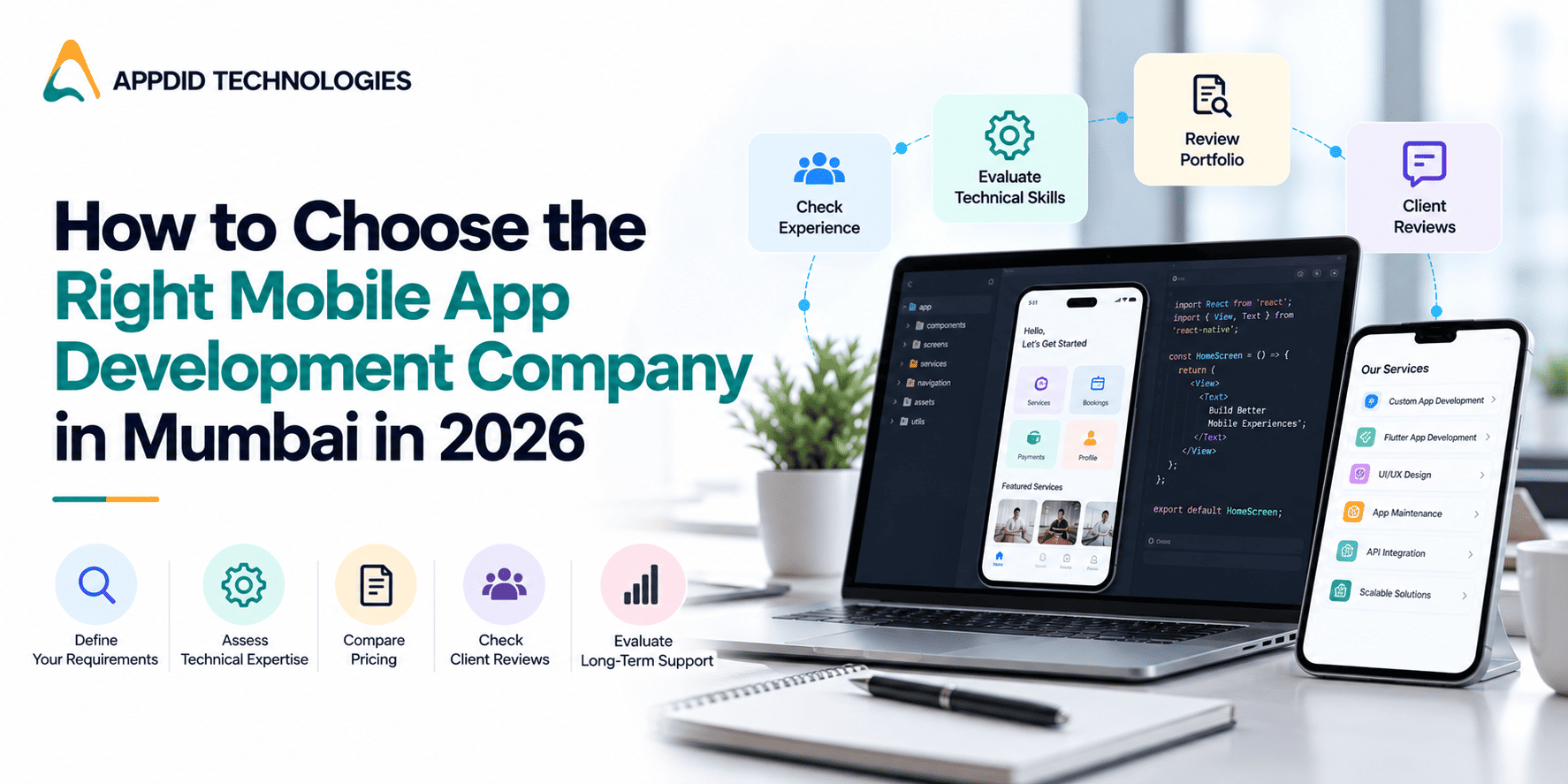
Choosing the right mobile app development company in Mumbai is an important decision for businesses planning to build a mobile application. Whether you want to develop an ecommerce platform, healthcare application, business management solution or customer-facing mobile app, the development partner you select can influence the application's functionality, performance, security and long-term scalability.
Mumbai has businesses across industries such as finance, healthcare, retail, real estate, logistics, education and manufacturing. Their application requirements can vary significantly, making it important to work with a development team that understands your business objectives and technical requirements. Before making a decision, explore the available mobile app development services in Mumbai and review the company's portfolio to understand its project experience. You should also evaluate whether it offers the right technology options, including Android app development and iOS development.
However, choosing a development partner should not depend only on pricing or the number of services listed on a website. Businesses need to assess technical expertise, industry experience, development processes, communication, security practices and post-launch support.
This guide explains how to evaluate a mobile application development company in Mumbai, what questions to ask before hiring developers and which factors can help you make an informed decision.
Why Businesses in Mumbai Need Mobile App Development
Mobile applications have become an important digital channel for businesses looking to improve customer engagement, simplify operations and provide convenient access to their services.
Companies in Mumbai operate across different industries, each with specific digital requirements.
For example:
-
Healthcare: Hospitals, clinics and healthcare providers may require appointment booking, patient management and telemedicine functionality.
-
Real estate: Property businesses may need applications for property listings, enquiry management, site visits and customer communication.
-
Retail and ecommerce: Businesses can use mobile applications for product catalogues, shopping carts, online payments and order tracking.
-
Logistics: Logistics companies may require delivery tracking, driver management, route information and shipment updates.
-
Education: Educational institutions may need applications for course access, student communication, assessments and learning management.
-
Service businesses: Companies offering professional or home services may require booking systems, service-provider management and customer dashboards.
A custom application allows businesses to develop functionality around their specific workflows rather than relying entirely on generic software.
10 Factors to Consider When Choosing a Mobile App Development Company in Mumbai
1. Understand Your Business Requirements First
Before contacting a mobile app development company, define what you want the application to achieve.
A development project should begin with business requirements rather than immediately selecting features or technologies.
Consider the following questions:
-
What problem will the application solve?
-
Who will use the application?
-
Will it be customer-facing or designed for internal business operations?
-
Do you need an Android app, iOS app or both?
-
Will the application require a web-based admin dashboard?
-
Does it need a payment gateway or third-party API integration?
-
What is the expected number of users?
-
Which features are essential for the initial launch?
For example, a Mumbai-based real estate business may need property listings, enquiry management, location-based search and appointment scheduling. An ecommerce business may prioritize product management, secure checkout, order tracking and customer accounts.
Having clear requirements helps development companies provide more accurate proposals and project estimates.
2. Check the Company's Portfolio and Previous Projects
A company's portfolio provides an indication of its development experience and technical capabilities.
Before selecting an app development company in Mumbai, review its previous projects and assess whether the applications demonstrate relevant functionality.
Look for experience in areas such as:
-
Custom mobile application development
-
Ecommerce application development
-
Healthcare application development
-
CRM and business applications
-
Android and iOS applications
-
API and third-party integrations
-
Admin dashboards and backend systems
Do not evaluate a portfolio only by the number of applications displayed. Understand the purpose of each project, the features implemented and the technical challenges addressed.
You can explore Appdid's portfolio to review its application development work and understand its project capabilities.
3. Evaluate Android, iOS and Cross-Platform Expertise
Technology selection is an important part of mobile application development. The right platform depends on your target audience, functionality, performance requirements and available budget.
A reliable development company should explain the differences between the available approaches instead of recommending one technology for every project.
Android App Development
Android applications are suitable for businesses targeting users across Android-supported smartphones and devices.
Consider Android development when your target audience primarily uses Android devices or your application requires Android-specific functionality.
Learn more about Android app development in Mumbai.
iOS App Development
iOS applications are developed for Apple's mobile ecosystem. Businesses targeting iPhone users or requiring iOS-specific functionality may need a dedicated iOS application.
Explore iOS app development services in Mumbai.
Cross-Platform App Development
Cross-platform development allows businesses to build applications for multiple platforms using a shared development approach.
It may be suitable when you want to support Android and iOS while managing development resources efficiently.
Read about native vs cross-platform app development to understand the differences before choosing an approach.
4. Look for Industry-Specific Development Experience
Every industry has different application requirements. A development team should understand the workflows, user expectations and integrations relevant to your business.
For example, a healthcare application may require patient registration, appointment scheduling and secure handling of sensitive information.
An ecommerce application may need product catalogues, payment gateway integration, order management and inventory synchronization.
A real estate application may require property listings, enquiry tracking, location-based features and lead management.
If you are planning a specialized application, evaluate whether the company understands the functionality required for your industry.
You can explore Appdid's solutions for healthcare app development, ecommerce app development and real estate app development.
5. Evaluate UI/UX Design Capabilities
The user experience directly affects how people interact with your application.
An application may have advanced technical functionality, but complicated navigation or confusing screens can make it difficult to use.
Before selecting a development partner, understand its approach to UI/UX design.
Important considerations include:
-
Simple navigation and clear layouts
-
Consistent design elements
-
Easy registration and login processes
-
Responsive interface design
-
Accessible buttons and readable content
-
User-friendly forms and checkout processes
-
Consistent experience across supported devices
Ask whether the development team prepares wireframes or prototypes before beginning full-scale development.
Reviewing the proposed design early can help identify usability problems before they become expensive to change.
6. Check Backend Development and API Integration Capabilities
A mobile application requires more than its frontend interface. The backend manages important operations such as user authentication, data storage, business logic, notifications and communication with external services.
Depending on your application, backend functionality may include:
-
User account management
-
Database management
-
Admin dashboard functionality
-
Payment processing
-
Push notifications
-
Data synchronization
-
Third-party API integrations
-
Reporting and analytics
For example, an ecommerce application may need to connect with payment gateways, inventory systems and delivery services.
A healthcare application may require integration with appointment management or other existing systems.
Read Appdid's guide to API integration in mobile app development to understand how applications communicate with external services.
7. Understand the Mobile App Development Process
A professional mobile app development company should follow a structured process that makes project requirements, deliverables and milestones clear.
A typical development process includes:
Requirement Analysis: The team understands your business objectives, target users, application features and technical requirements.
Planning and Documentation: The project scope, technology choices, timelines and development milestones are established.
UI/UX Design: Wireframes, prototypes and interface designs are prepared for review.
Application Development: Developers build the frontend, backend, database and required integrations.
Testing and Quality Assurance: The application is tested for functionality, usability, compatibility, security and performance.
Deployment: The application is prepared for release through the relevant app distribution platforms.
Maintenance and Updates: Post-launch support addresses bugs, compatibility changes, security updates and new feature requirements.
Ask the company how it handles project reviews, feedback, testing and approvals at each stage.
For a deeper understanding, read how to choose the right mobile app development company.
8. Compare App Development Cost and Pricing Transparency
The cost of developing a mobile application in Mumbai depends on its features, complexity, technology stack, integrations, design requirements and development timeline.
A basic application with limited functionality will generally require a different level of effort from an advanced platform with multiple user roles, real-time features and complex backend operations.
Before accepting a proposal, check whether the estimate explains:
-
Features included in the project
-
Android and iOS development requirements
-
UI/UX design scope
-
Backend and database development
-
Third-party integrations
-
Testing and deployment
-
Maintenance and support
-
Additional costs or exclusions
Avoid selecting a company based only on the lowest quotation. A proposal should clearly explain what you will receive and what is excluded.
For additional budgeting guidance, read mobile app development cost in India.
9. Prioritize Application Security and Scalability
Security and scalability should be considered during the planning stage rather than added only after development.
Depending on the application's purpose, important security requirements may include:
-
Secure user authentication
-
Role-based access control
-
Encrypted data transmission
-
Secure API communication
-
Database protection
-
Regular backups
-
Activity monitoring
-
Secure payment processing
Scalability is equally important. The application should be designed with expected user growth, data requirements and future functionality in mind.
Ask the development company how it plans to manage performance, database growth, infrastructure requirements and future feature additions.
You can also read why encryption is important for app developers for more information about mobile application security.
10. Check Post-Launch Support and Maintenance
Launching an application is not the end of the development process.
After deployment, businesses may need technical support, performance monitoring, bug fixes, security updates and improvements based on user feedback.
Before signing an agreement, clarify:
-
What maintenance services are included?
-
How are technical issues reported?
-
What is the process for handling critical bugs?
-
Are operating system compatibility updates covered?
-
How are future feature requests estimated?
-
Who manages application updates after launch?
A clear post-launch support arrangement helps businesses maintain their applications and plan future improvements.
How Much Does It Cost to Hire a Mobile App Development Company in Mumbai?
The cost of hiring a mobile app development company in Mumbai depends on the type of application you want to build and the technical work involved.
Some projects require only a few core features, while others need complex workflows, multiple user roles, real-time communication and external integrations.
The following factors usually influence the development budget:
|
Cost Factor |
How It Affects Development |
|
Application complexity |
More complex functionality requires additional development and testing |
|
Platform selection |
Android, iOS or both affect the project scope |
|
UI/UX design |
Custom screens and user journeys require design effort |
|
Backend development |
Databases, APIs and business logic influence technical complexity |
|
Third-party integrations |
Payment gateways, maps and external systems add integration work |
|
Security requirements |
Authentication, permissions and data protection require planning |
|
Maintenance |
Ongoing updates and support add to the long-term cost |
For an accurate estimate, businesses should prepare a feature list and discuss their requirements with the development team.
Questions to Ask Before Hiring Mobile App Developers in Mumbai
Before finalizing a development partner, ask questions that help you understand its experience, process and project commitments.
-
Have you developed applications with similar functionality?
-
Do you provide both Android and iOS app development?
-
What technology stack would you recommend for this project and why?
-
Do you provide UI/UX design and backend development?
-
How will third-party integrations be managed?
-
What testing procedures do you follow before deployment?
-
How do you handle project updates and feedback?
-
What is included in the development quotation?
-
Do you provide post-launch maintenance and technical support?
-
What documentation and project deliverables will be provided?
The answers can help you compare development companies based on their actual capabilities rather than marketing claims.
Why Choose Appdid Technologies for Mobile App Development in Mumbai?
Choosing a development partner requires evaluating technical expertise, project experience, development processes and the ability to understand business requirements.
Appdid Technologies works on mobile application development projects involving different business requirements and application functionalities.
Businesses planning a custom mobile application can explore development options based on their preferred platforms, features, integrations and operational objectives.
The project planning process should focus on understanding the application concept, identifying essential features, selecting an appropriate technology approach and defining the development scope.
Whether you are planning an Android application, an iOS application, an ecommerce platform or a specialized business solution, the development approach should align with your intended users and long-term requirements.
Explore Appdid's mobile app development services to learn more about its capabilities. You can also visit the Appdid website or contact the development team to discuss your project requirements.
Conclusion
Choosing the right mobile app development company in Mumbai requires more than comparing quotations. Businesses should evaluate technical capabilities, portfolio experience, platform expertise, industry understanding, UI/UX design, security practices and post-launch support.
A clear understanding of your requirements will help you identify a development partner capable of translating your business objectives into a functional mobile application.
Before making your final decision, compare proposals, review previous projects and discuss the development process in detail. Selecting the right team can help establish a strong technical foundation for your application and its future growth.
Frequently Asked Questions
1. How do I choose the best mobile app development company in Mumbai?
Evaluate the company's portfolio, technical expertise, industry experience, Android and iOS development capabilities, pricing transparency, testing process and post-launch support. Also, check whether the team understands your business requirements before proposing a solution.
2. How much does mobile app development cost in Mumbai?
Mobile app development cost in Mumbai depends on application complexity, features, platform selection, design requirements, backend development and integrations. A detailed estimate can be prepared after understanding the project scope.
3. How long does it take to develop a mobile application?
The timeline depends on the number of features, application complexity, design requirements, integrations and testing. A basic application generally requires less development effort than a platform with advanced functionality and multiple user roles.
4. Should I choose Android or iOS app development?
The decision depends on your target audience, business objectives, budget and required functionality. If your users are spread across both platforms, you may consider developing for Android and iOS or evaluating a cross-platform approach.
5. Does a mobile app development company provide post-launch support?
Many development companies offer post-launch services such as bug fixes, maintenance, performance monitoring, security updates and feature improvements. Confirm the exact support arrangements and maintenance terms before signing the project agreement.