
Why Is Encryption Important for App Developers? 2026 Guide
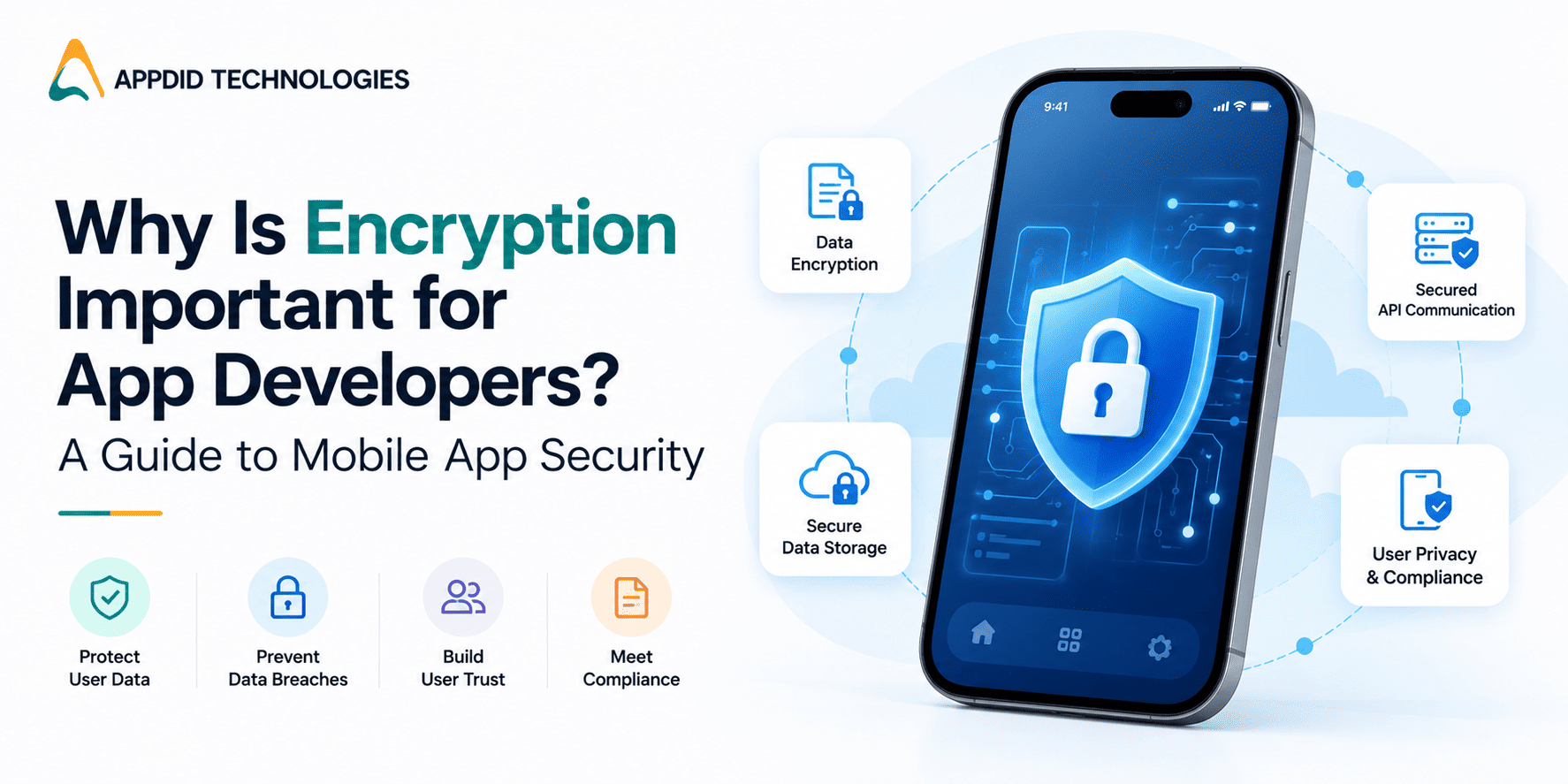
Why Is Encryption Important for App Developers? A Guide to Mobile App Security
Mobile applications handle a large amount of information every day. Depending on the type of application, this can include names, email addresses, passwords, payment information, location data, business records and other sensitive information.
This raises an important question: why is encryption important for app developers?
Encryption helps protect data by converting readable information into a format that cannot be easily understood without the appropriate key or mechanism to decrypt it. It is an important part of building applications that need to protect user and business information.
For developers, encryption is not just a security feature added at the end of a project. It needs to be considered throughout the application architecture, including data transmission, storage, authentication, APIs and third-party integrations.
What Is Encryption in App Development?
Encryption is a security technique that transforms readable data, known as plaintext, into an encoded form called ciphertext.
The encrypted information can only be converted back into a usable format through the appropriate decryption process.
For example, when a user enters sensitive information into an application, developers need to consider how that information travels between the app and server and how it is stored.
Encryption can help protect information during these stages.
This is particularly important for applications such as mobile app development, healthcare platforms, financial applications, eCommerce systems and business applications that process sensitive information.
Why Is Encryption Important for App Developers?
Encryption provides an additional layer of protection against unauthorised access to sensitive information.
Here are some of the main reasons developers need to consider it.
1. Protecting Sensitive User Data
Mobile applications can collect and process a wide range of personal information.
This may include:
-
Names
-
Email addresses
-
Phone numbers
-
Password-related information
-
Addresses
-
Location data
-
Health information
-
Payment information
-
Business records
If sensitive information is exposed, the consequences can include privacy issues, account compromise and financial or reputational damage.
Encryption helps make intercepted or improperly accessed data harder to understand without the necessary decryption mechanism.
2. Securing Data During Transmission
Data frequently moves between a mobile application and its backend server.
For example:
User → Mobile App → API → Server → Database
If information is transmitted without appropriate protection, attackers may attempt to intercept it.
Encryption protocols such as TLS help protect data transmitted between applications and servers.
This is why secure communication should be considered when developers build applications that rely heavily on APIs.
Businesses planning complex integrations can also refer to Appdid's guide on API integration in mobile app development.
3. Protecting Stored Information
Encryption is not limited to information travelling across the internet.
Data stored on servers, databases or devices may also require protection.
For example, a business application could store:
-
Customer records
-
Order information
-
Employee data
-
Documents
-
Transaction records
-
Business reports
If an unauthorised person gains access to the underlying storage system, properly encrypted information can provide an additional security barrier.
Developers therefore need to consider both data in transit and data at rest.
4. Improving Mobile App Security
Security should be part of the application architecture rather than something considered only before launch.
Encryption works alongside other security measures such as:
-
Authentication
-
Authorisation
-
Secure APIs
-
Access controls
-
Input validation
-
Secure session management
-
Device security
-
Monitoring
-
Regular security testing
No single security mechanism can protect an application from every threat.
A well-designed application combines multiple layers of protection.
5. Protecting Authentication Information
User authentication is one of the most important parts of many mobile applications.
Applications need to protect account-related information and prevent unauthorised users from accessing accounts.
Developers should avoid storing passwords in plain text.
Instead, passwords should generally be handled using appropriate password hashing mechanisms designed specifically for password storage.
Encryption may also be used to protect other sensitive authentication-related information, depending on the architecture.
This distinction is important: encryption and password hashing are not the same thing.
6. Securing Payment Information
eCommerce and other transaction-based applications often process sensitive financial information.
For example, an application may interact with:
-
Payment gateways
-
Banking services
-
Card payment systems
-
Wallets
-
Subscription platforms
Developers need to make sure sensitive payment-related information is transmitted and handled securely.
In many cases, applications should avoid unnecessarily storing payment credentials and instead rely on established payment providers and tokenisation mechanisms where appropriate.
For businesses building commerce applications, eCommerce and food delivery app development can involve several security and integration considerations.
7. Protecting Healthcare Data
Healthcare applications can handle particularly sensitive information.
Depending on the application, this may include:
-
Patient information
-
Medical records
-
Prescriptions
-
Appointment information
-
Diagnostic information
-
Communication between patients and healthcare professionals
Encryption can help protect this information while it is transmitted and stored.
However, encryption is only one part of healthcare application security. Access controls, authentication, audit mechanisms, secure APIs and appropriate compliance practices also need to be considered.
Businesses interested in this category can explore healthcare app development.
Encryption for APIs and Backend Systems
Modern mobile applications frequently communicate with backend systems through APIs.
An application might send a request such as:
-
Login request
-
Customer information
-
Product search
-
Order details
-
Payment status
-
Appointment request
These communications need to be protected against unauthorised interception and manipulation.
Secure HTTPS connections using TLS are a fundamental part of protecting data in transit.
Developers should also consider:
-
API authentication
-
Access tokens
-
Authorisation
-
Rate limiting
-
Input validation
-
Secure error handling
-
API monitoring
Encryption therefore needs to be considered as part of the wider API security strategy.
Encryption at Rest vs Encryption in Transit
Two common concepts developers should understand are encryption at rest and encryption in transit.
|
Security Area |
Meaning |
Example |
|
Encryption in transit |
Protects data while it moves between systems |
App communicating with an API |
|
Encryption at rest |
Protects stored data |
Information stored in a database |
|
Device-level protection |
Protects data stored on a device |
Local application data |
|
Backup encryption |
Protects stored backups |
Cloud or server backups |
A secure application may need more than one of these approaches depending on the type of information it handles.
What Encryption Methods Do Developers Use?
The exact technology depends on the use case and architecture.
Common cryptographic approaches include:
Symmetric Encryption
The same secret key is used for encryption and decryption.
It can be useful when systems need to efficiently encrypt and decrypt large amounts of data.
Asymmetric Encryption
Asymmetric cryptography uses a public key and a private key.
It is commonly associated with secure communications, authentication and key exchange mechanisms.
Hashing
Hashing transforms data into a fixed-length representation.
It is commonly used for password storage and data integrity rather than reversible encryption.
Developers should select established cryptographic standards and libraries rather than attempting to create their own encryption algorithms.
Why Developers Should Not Create Their Own Encryption
Cryptography is highly complex.
An encryption algorithm can look mathematically sound and still contain weaknesses because of poor implementation, weak key management or incorrect usage.
Developers should therefore rely on well-established cryptographic algorithms, security libraries and platform capabilities.
The goal is not to invent a new encryption method. The goal is to implement proven security mechanisms correctly.
Common Encryption Mistakes in Mobile Apps
Even when developers understand the importance of encryption, implementation mistakes can weaken application security.
Some common problems include:
Storing Sensitive Data in Plain Text
Sensitive information should not be unnecessarily stored without appropriate protection.
Hardcoding Encryption Keys
Putting secret keys directly inside application source code can expose them to attackers.
Using Weak or Outdated Cryptography
Developers should use modern, well-reviewed cryptographic standards appropriate to the use case.
Ignoring API Security
Encrypting local data does not protect an application if sensitive information is transmitted insecurely.
Poor Key Management
Encryption is only as strong as the way its keys are managed.
Overlooking Local Storage
Applications may store tokens, cached information or other data locally on the device. Developers should assess whether that data needs protection.
Encryption and Custom Business Applications
Encryption becomes particularly relevant when developing applications for businesses that process internal or customer information.
For example, a custom CRM application may contain:
-
Customer information
-
Sales data
-
Employee information
-
Deal records
-
Communication history
A field-service application could contain customer addresses, service records and employee information.
A manufacturing application might process inventory, purchase orders and internal business data.
In such cases, security requirements should be considered during the planning stage rather than added after development.
Businesses considering custom applications can explore CRM software development to understand how specialised business applications can be structured.
How App Developers Can Build More Secure Applications
A practical security approach can include several steps.
Start With a Data Inventory
Identify what information the application collects, processes and stores.
Classify Sensitive Data
Not every piece of information requires the same level of protection.
Identify which data is confidential, personal, financial or otherwise sensitive.
Protect Data in Transit
Use secure communication protocols for connections between the application, APIs and backend systems.
Protect Stored Data
Assess whether sensitive information stored on devices, servers, databases and backups requires encryption.
Use Secure Key Management
Encryption keys should be managed separately from the data they protect and handled using appropriate security mechanisms.
Minimise Data Collection
If the application does not need certain sensitive information, avoiding unnecessary collection can reduce security exposure.
Test Security Regularly
Security testing should be part of the development and maintenance lifecycle.
Is Encryption Enough to Secure a Mobile App?
No.
This is an important point for developers and businesses.
Encryption protects data, but application security involves much more.
A secure mobile application may also require:
-
Strong authentication
-
Role-based access control
-
Secure APIs
-
Input validation
-
Session management
-
Dependency management
-
Secure coding practices
-
Vulnerability testing
-
Monitoring
-
Regular updates
For example, encrypted data can still be exposed if an attacker gains access to a legitimate user's account.
Security therefore needs to be approached as a complete system rather than a single feature.
Why Encryption Should Be Planned Early
Adding security after an application has already been built can require architectural changes.
When security is considered during the planning stage, developers can make better decisions about:
-
Data storage
-
API architecture
-
Authentication
-
Key management
-
User permissions
-
Database design
-
Third-party services
This can reduce the risk of having to redesign major parts of an application later.
For businesses planning a new application, understanding how to choose the right mobile app development company can also help when evaluating a development partner's approach to security.
Why Appdid for Secure App Development?
Appdid Technologies develops custom mobile applications based on business requirements, including applications that require backend systems, APIs, authentication and third-party integrations.
Security requirements can be considered as part of the application's architecture rather than treated as an afterthought.
Whether the project involves a healthcare platform, CRM, eCommerce application, field-service solution or another custom business application, the appropriate security controls depend on the type of data and functionality involved.
You can explore the Appdid portfolio to see examples of application development work or contact Appdid to discuss your application requirements.
Final Thoughts
So, why is encryption important for app developers?
Because mobile applications increasingly handle information that users and businesses expect to remain private and protected.
Encryption can help protect data during transmission and storage, support secure application architecture and reduce the impact of certain unauthorised access scenarios.
However, encryption should not be treated as the entire security strategy. Developers also need to consider authentication, authorisation, API security, key management, secure coding and ongoing security testing.
For businesses planning a new mobile application, security should be part of the architecture from the beginning rather than something added just before launch.
FAQs
1. Why is encryption important for app developers?
Encryption helps protect sensitive information from unauthorised access by transforming readable data into an encoded form that requires the appropriate key or mechanism to access.
2. Should mobile apps encrypt data stored on a device?
Sensitive locally stored information may require protection depending on the type of data and application architecture. Developers should minimise sensitive local storage and use appropriate platform security mechanisms where needed.
3. Is HTTPS the same as encryption?
HTTPS uses TLS to protect communications between systems. It provides encryption for data in transit along with authentication and integrity protections. It is an important part of secure web and mobile API communication.
4. Is encryption enough to make an app secure?
No. Encryption is one layer of security. Secure authentication, authorisation, API protection, key management, secure coding and security testing are also important.
5. Should developers create their own encryption algorithms?
Generally, no. Developers should rely on established cryptographic algorithms and well-maintained security libraries rather than creating their own cryptographic systems.