Custom Healthcare App Development in Mumbai (2026)
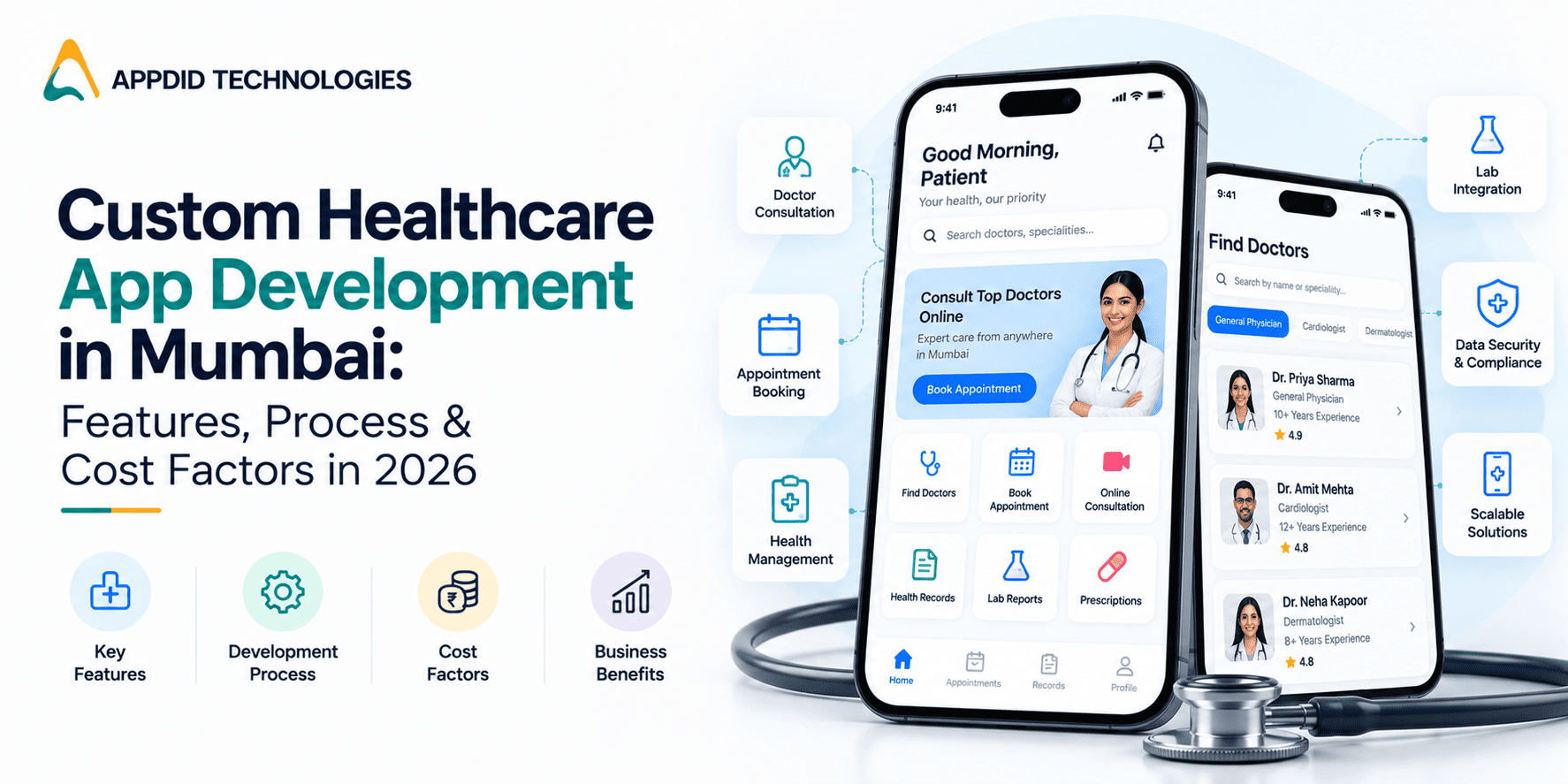
Custom Healthcare App Development in Mumbai: Features, Process & Cost Factors in 2026
Healthcare organizations are increasingly using digital applications to improve patient communication, streamline appointments and make healthcare services more accessible. From doctor appointment booking and telemedicine consultations to patient portals and remote health monitoring, mobile applications can support different stages of the healthcare journey.
For hospitals, clinics, diagnostic centres and healthcare businesses in Mumbai, custom healthcare app development offers an opportunity to build digital solutions around their specific operational requirements. Instead of relying entirely on generic software, organizations can develop applications that connect patients, doctors, administrators and other stakeholders through customized workflows.
However, building a healthcare application involves more than designing an interface. Businesses must consider patient experience, data security, integrations, platform selection, scalability and ongoing maintenance.
This guide explains the key features, development process and cost factors involved in custom healthcare app development in Mumbai, helping healthcare businesses plan their projects more effectively.
What Is Custom Healthcare App Development?
Custom healthcare app development involves designing and building software applications specifically for healthcare-related needs. These applications can help patients access services, enable doctors to manage appointments and support healthcare organizations in coordinating their operations.
Unlike generic applications with predefined functionality, custom healthcare applications are developed around specific business requirements, user roles and workflows.
For example, a clinic may need an appointment booking application with digital reminders and patient records. A hospital may require a patient-facing application connected to appointment management, billing and other internal systems. A healthcare service provider may need a platform for consultations, follow-ups and communication.
The exact functionality depends on the organization's services, users and operational objectives.
Businesses evaluating their requirements can explore Appdid's healthcare app development services to understand how custom mobile applications can support healthcare-related workflows.
Why Healthcare Businesses in Mumbai Need Custom Mobile Applications
Mumbai has a diverse healthcare environment that includes hospitals, independent clinics, diagnostic centres, specialist practices and other healthcare service providers. These organizations may have different requirements for managing appointments, communicating with patients and coordinating services.
A custom healthcare application can help address several operational challenges.
1. Simplifying Appointment Booking
Patients may need to contact healthcare providers to check availability, schedule consultations or reschedule appointments.
An appointment booking application can allow patients to view available time slots, select a doctor and receive booking confirmations. Automated reminders can also help patients remember upcoming appointments.
For clinics managing frequent appointment requests, these features can reduce repetitive administrative tasks.
2. Improving Patient Communication
Healthcare providers often need to communicate appointment updates, consultation instructions, follow-up reminders and other relevant information.
A healthcare application can bring selected communication features into one platform, making it easier for patients to access updates and manage their interactions with a provider.
The communication features should be designed around the type of healthcare service and the information that can appropriately be shared.
3. Supporting Telemedicine Services
Telemedicine functionality can allow patients to consult healthcare professionals remotely where appropriate.
Depending on the application, this may include appointment scheduling, secure video consultations, consultation history, digital prescriptions and follow-up reminders.
Organizations considering remote consultation features should assess clinical workflows, privacy requirements, technical reliability and applicable regulations before development.
4. Streamlining Healthcare Operations
A custom application can connect patient-facing features with administrative workflows.
For example, a clinic may want appointment requests to appear in its internal scheduling system. A diagnostic centre may need patients to access selected test-related information through an application.
The benefits depend on how effectively the application integrates with existing processes rather than simply digitizing individual tasks.
5. Supporting Better Patient Experiences
A well-designed healthcare application can make it easier for patients to access relevant information, manage appointments and communicate with healthcare providers.
For organizations serving patients across Mumbai, a mobile application can provide a consistent digital access point without requiring patients to rely exclusively on phone calls or in-person administrative visits.
Essential Features of a Custom Healthcare Application
The required features depend on whether the application is designed for a hospital, clinic, diagnostic centre, telemedicine provider or another healthcare business.
1. Patient Registration and Profiles
Patient registration allows users to create accounts and manage relevant profile information.
Depending on the application, patient profiles may include contact details, appointment history, preferences and access to selected health-related records.
The application should collect only the information necessary for its intended functionality and protect it through appropriate access controls.
2. Doctor Profiles and Appointment Scheduling
An appointment management module can display doctor profiles, consultation types, available time slots and booking details.
Useful functionality may include:
-
Doctor availability
-
Appointment booking and cancellation
-
Rescheduling options
-
Booking confirmations
-
Appointment reminders
-
Consultation history
For healthcare providers in Mumbai, these features can support appointment management across different doctors, departments or clinic locations.
3. Telemedicine and Video Consultations
Telemedicine features allow healthcare providers to offer eligible consultations remotely.
Depending on the requirements, the application may include video calling, consultation scheduling, secure communication and post-consultation instructions.
Explore custom healthcare mobile app development for further information about planning healthcare applications around specific requirements.
4. Electronic Health Records Integration
Some healthcare applications need to connect with electronic health record systems or other existing clinical software.
Integration may allow authorized users to access relevant patient information without maintaining disconnected records across multiple systems.
The scope must be carefully defined because health records require appropriate permissions, secure data handling and compatibility with the systems involved.
5. Online Payments and Billing
Applications that support paid consultations or healthcare services may require online payment functionality.
Depending on the business model, the module may include payment processing, transaction confirmations, invoices and payment history.
Payment integrations should be selected according to the organization's requirements, supported payment methods and security obligations.
6. Push Notifications and Reminders
Notifications can inform users about appointment confirmations, schedule changes, upcoming consultations and other relevant updates.
Notification settings should allow businesses to send appropriate messages without overwhelming patients or exposing sensitive information through device notifications.
7. Admin Dashboard
An administrative dashboard helps authorized staff manage application activities.
Depending on the scope, it may support:
-
Patient account management
-
Doctor and department management
-
Appointment scheduling
-
Service configuration
-
User access management
-
Reports and operational analytics
-
Notification management
The dashboard should provide access according to each user's responsibilities.
8. Healthcare Data Security
Healthcare applications can handle sensitive personal and health-related information. Security must therefore be incorporated into the architecture and development process.
Important considerations include secure authentication, role-based permissions, encrypted communication, protected data storage, audit logging, backup procedures and secure API access.
Organizations should also assess applicable Indian data protection requirements and any healthcare-specific rules relevant to their services.
Read why encryption is important for app developers to understand one of the important components of application security.
Healthcare App Development Process
A structured development process helps healthcare organizations define requirements, manage complexity and prepare for deployment.
Step 1: Identify the Healthcare Business Requirements
Start by defining the main problem the application should solve.
A hospital may prioritize appointment management and patient access. A clinic may focus on doctor scheduling and follow-up communication. A telemedicine provider may require consultation workflows and secure video functionality.
Identify the intended users, required features, operational constraints and expected outcomes before deciding on the technology.
Step 2: Conduct Requirement Analysis
The development team should document user journeys, application functionality, integrations, permissions and technical requirements.
This stage should also identify which systems need to exchange information and what types of data the application will process.
Clear requirements help establish a realistic development scope and reduce the likelihood of expensive changes later.
Step 3: Design the User Interface and Experience
Healthcare applications should be easy to navigate for users with different levels of digital familiarity.
The design should make important actions such as booking appointments, accessing relevant information and contacting the provider straightforward.
Wireframes and prototypes can be reviewed with stakeholders before development begins.
Step 4: Select the Technology Stack
The technology stack depends on the required platforms, integration needs, expected usage and maintenance requirements.
A healthcare application may need a web-based administrative dashboard alongside Android and iOS applications.
Depending on the project, businesses can evaluate Android app development, iOS app development or cross-platform app development.
The best approach depends on the application's functionality, performance requirements, budget and long-term technical plans.
Step 5: Develop the Application and Integrations
Development typically includes the user interface, backend services, database structure, authentication, access permissions and core healthcare workflows.
Where necessary, the application may also integrate with appointment systems, payment gateways, communication services or existing healthcare software.
Integration requirements should be identified early because they can affect development effort, testing and deployment.
For a broader technical perspective, read Appdid's guide to API integration in mobile app development.
Step 6: Test Functionality and Security
Testing should verify that the application behaves as expected and protects information appropriately.
Important testing areas include:
-
Functional testing
-
User access and permission testing
-
API and integration testing
-
Security testing
-
Performance testing
-
Device and compatibility testing
-
User acceptance testing
Healthcare organizations should also validate important workflows with the relevant operational stakeholders before launch.
Step 7: Deploy and Maintain the Application
Deployment involves preparing the production environment, configuring required services and releasing the application to its intended users.
After launch, organizations may need technical support, monitoring, security updates, bug fixes and feature improvements.
A maintenance plan helps keep the application reliable as business requirements and technical dependencies change.
Factors Affecting Healthcare App Development Cost in Mumbai
Healthcare app development cost varies according to the scope and technical complexity of the project. There is no single price that applies to every application.
The main factors include the following.
1. Number and Complexity of Features
A basic appointment booking application has different requirements from a platform supporting telemedicine, patient records, billing and multiple user roles.
Each additional feature can require design, development, integration and testing.
2. Platform Requirements
Developing for a single platform differs from delivering an application for Android, iOS and the web.
The cost depends on the amount of functionality required on each platform and whether components can be shared.
3. Third-Party Integrations
Integrating with healthcare software, payment gateways, video consultation services or notification providers can increase project complexity.
The effort depends on API availability, authentication, data mapping and the reliability requirements of each integration.
4. Security and Compliance Requirements
Applications processing sensitive information require suitable security controls and careful access management.
The necessary effort depends on the information handled, the application architecture and the legal or contractual obligations that apply to the organization.
5. UI/UX Design
The number of screens, user roles, workflows and design revisions affects the effort required to deliver the application.
A system designed for patients, doctors and administrators may require different interfaces for each user group.
6. Testing and Maintenance
Testing, deployment preparation and ongoing maintenance should be included in the project budget.
Businesses should also consider hosting, third-party service fees and future improvements when estimating the total cost of ownership.
To learn more about the broader planning considerations, explore Appdid's healthcare app development guide.
How to Choose a Healthcare App Development Company in Mumbai
Selecting a suitable development partner is important because healthcare applications involve operational workflows, integrations and sensitive information.
Before choosing a healthcare app development company in Mumbai, evaluate the following factors.
Healthcare project understanding: The development team should understand your intended users, healthcare workflows and the importance of protecting sensitive information.
Technical capabilities: Review the team's experience with mobile applications, backend development, databases, APIs and third-party integrations.
Security approach: Ask how authentication, permissions, encryption, testing and secure data handling will be addressed.
Clear project scope: The proposal should explain the features, platforms, integrations, deliverables and assumptions included in the project.
Testing and quality assurance: Confirm how the application will be tested across supported devices, user roles and business workflows.
Post-launch support: Discuss maintenance, bug fixes, monitoring, security updates and future development.
Relevant project experience: Review previous work and assess whether the team's technical capabilities align with your requirements.
You can explore Appdid's portfolio to review project experience and learn more about its mobile app development services in Mumbai.
How Appdid Technologies Can Help
Appdid Technologies provides mobile application development services for businesses with different operational and technical requirements.
For healthcare organizations planning a custom application, the development process should begin with understanding the intended users, essential features, existing systems and security needs.
The project scope can then be planned around requirements such as appointment scheduling, patient-facing functionality, administrative dashboards, integrations and platform selection.
A clearly defined scope helps businesses understand the development work involved before committing to a project.
If you are evaluating a healthcare application for a hospital, clinic, diagnostic centre or healthcare service provider in Mumbai, you can contact Appdid Technologies to discuss your requirements.
Conclusion
Custom healthcare app development in Mumbai can help healthcare organizations create digital experiences tailored to their patients, staff and operational processes.
From appointment booking and telemedicine to administrative dashboards and healthcare system integrations, the right features depend on the organization's specific objectives.
Successful development requires more than selecting features. Businesses must also plan the user experience, technology stack, security controls, integrations, testing and ongoing maintenance.
By defining requirements early and prioritizing features according to business needs, healthcare organizations can make better development decisions and build applications designed to support their long-term goals.
Frequently Asked Questions
1. What is custom healthcare app development?
Custom healthcare app development involves building a mobile or web application tailored to healthcare requirements. It may include appointment booking, telemedicine, patient profiles, administrative dashboards, notifications and integrations with existing healthcare systems.
2. How much does healthcare app development cost in Mumbai?
The cost depends on the application's features, platforms, integrations, security requirements and technical complexity. A basic appointment application has different development requirements from an advanced healthcare platform. An accurate estimate requires a detailed project scope.
3. What features should a healthcare mobile application include?
Common features include patient registration, doctor profiles, appointment scheduling, notifications, administrative dashboards and secure communication. Depending on the project, the application may also require telemedicine, payments or integration with existing healthcare software.
4. How long does it take to develop a healthcare application?
The timeline depends on the number of features, design requirements, integrations, security considerations and testing scope. A clear set of requirements helps the development team estimate the timeline more accurately.
5. How do I choose a healthcare app development company in Mumbai?
Evaluate the company's technical capabilities, relevant project experience, security practices, integration expertise, testing process and post-launch support. Request a detailed proposal that explains the scope, deliverables, assumptions and maintenance arrangements.