How to Choose an Ecommerce Payment Gateway in India
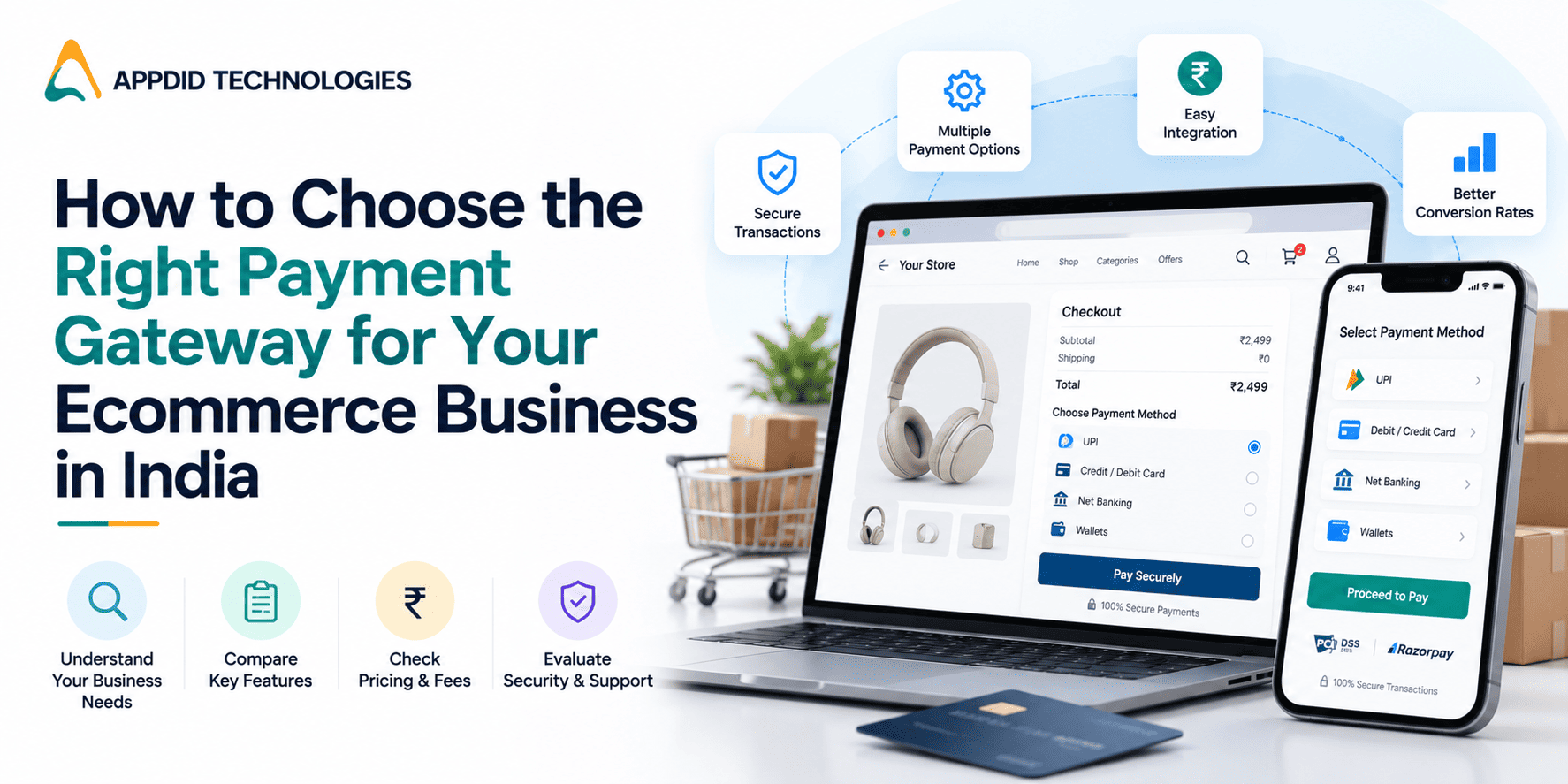
How to Choose the Right Payment Gateway for Your Ecommerce Business in India
Online payments are an essential part of running an ecommerce business. Whether a company sells clothing, electronics, groceries, beauty products or specialized services, customers expect a convenient and secure checkout experience.
Choosing the right payment gateway for an ecommerce business can influence checkout completion, customer trust, payment success rates and operational efficiency. A complicated payment process or limited payment options may discourage customers from completing their purchases.
For businesses selling online in India, selecting a payment gateway involves evaluating supported payment methods, transaction charges, security standards, settlement processes, integration capabilities and compatibility with the existing ecommerce platform.
This guide explains how to choose an ecommerce payment gateway in India, the features to evaluate, common integration challenges and the factors businesses should consider before implementing an online payment solution.
What Is a Payment Gateway in Ecommerce?
A payment gateway is a technology service that facilitates the secure transmission of payment information between a customer, an online business and the relevant payment processing systems.
When a customer places an order on an ecommerce website or mobile application, the payment gateway helps process the payment request through the supported payment method.
Depending on the provider and payment setup, the process may involve the payment gateway, payment processor, acquiring bank, card network, issuing bank or other payment participants.
A typical online payment process includes the following steps:
-
A customer adds products to the cart and proceeds to checkout.
-
The customer selects an available payment method.
-
The payment gateway securely transmits the payment request for processing.
-
The relevant payment systems authorize or decline the transaction.
-
The ecommerce platform receives the payment status.
-
The business updates the order status and initiates fulfilment according to its workflow.
A reliable payment integration should handle successful payments, declined transactions, pending statuses, refunds and payment verification correctly.
Businesses developing a new online store or application can explore Appdid's ecommerce app development services to understand how payment functionality fits into a broader ecommerce application.
Why Choosing the Right Ecommerce Payment Gateway Matters
A payment gateway is not simply a checkout feature. It affects how customers pay, how businesses reconcile transactions and how the ecommerce platform handles different payment scenarios.
1. Improves the Checkout Experience
Customers expect a checkout process that is straightforward, responsive and easy to understand.
A suitable payment gateway can support familiar payment methods and provide a consistent payment experience across supported devices.
Businesses should avoid unnecessary checkout steps and clearly communicate payment status so customers know whether their orders have been placed successfully.
2. Supports Multiple Payment Methods
Different customers prefer different ways to pay.
Depending on the provider, an ecommerce payment gateway in India may support:
-
UPI payments
-
Debit and credit cards
-
Net banking
-
Supported digital wallets
-
EMI or instalment options, where available
-
International card payments, subject to eligibility and provider support
The appropriate mix depends on the target audience, product category, order value and business model.
3. Helps Manage Payment Failures
Transactions may fail because of insufficient funds, authentication problems, temporary technical issues or payment provider errors.
A well-integrated system should communicate payment status clearly and allow customers to recover from eligible failures without creating duplicate orders or duplicate charges.
Businesses should also monitor payment success rates and investigate recurring failure patterns.
4. Supports Business Operations
Payment systems can provide transaction records, settlement reports, refund functionality and reconciliation tools.
These capabilities help businesses compare orders against payment records and identify discrepancies.
For ecommerce operations with frequent orders, reliable payment reporting can simplify financial administration.
5. Builds Customer Confidence
Customers need to feel confident when entering payment information online.
A secure checkout, clear payment instructions, transparent pricing and appropriate handling of payment errors can contribute to a more trustworthy purchasing experience.
Security depends on the complete payment implementation, not merely the name of the payment gateway provider.
Key Factors to Consider When Choosing a Payment Gateway in India
Before selecting a provider, evaluate its suitability for your business model and technical requirements.
1. Supported Payment Methods
Start by identifying the payment methods your customers are likely to use.
For example, a domestic ecommerce store may prioritize UPI, cards and net banking. A business serving international customers may need supported foreign currencies and international card acceptance.
Check whether the provider supports the payment methods relevant to your audience and whether any eligibility restrictions apply.
Offering more payment methods is not automatically better. The goal is to provide the options that serve your customers and business requirements.
2. Transaction Fees and Other Charges
Payment gateway pricing can affect ecommerce operating costs, particularly when transaction volumes increase.
Before choosing a provider, review its current commercial terms, including:
-
Per-transaction charges
-
Applicable taxes on fees
-
Payment method-specific pricing
-
International payment charges
-
Refund-related charges, where applicable
-
Chargeback or dispute fees
-
Settlement-related charges, if any
The exact pricing depends on the provider, payment method, business category, agreement and transaction type.
Do not compare providers solely on their advertised transaction rate. Review the complete fee structure and calculate the expected cost using your typical order value and transaction volume.
3. Security and Compliance
Payment security should be a priority when evaluating an ecommerce payment gateway.
Important considerations include secure communication, authentication requirements, access controls, transaction monitoring and the provider's approach to protecting payment information.
Businesses should also assess their responsibilities under applicable payment security standards and Indian regulatory requirements.
Where card payments are involved, understand the responsibilities associated with the applicable Payment Card Industry Data Security Standard (PCI DSS). Using a payment provider does not automatically remove every security obligation from the merchant.
For additional context on application security, read why encryption is important for app developers.
4. Integration With Your Ecommerce Platform
The gateway should work with your existing website, mobile application or ecommerce technology stack.
Depending on your setup, integration may involve:
-
Payment APIs
-
Provider-hosted checkout
-
Mobile SDKs
-
Website plugins
-
Webhooks for payment notifications
-
Backend payment verification
-
Refund and reconciliation APIs
Businesses building custom ecommerce applications should evaluate whether the provider's APIs and SDKs meet their technical requirements.
Review Appdid's guide to API integration in mobile app development to understand the role of APIs in connecting applications with external services.
5. Settlement Time and Reporting
Settlement determines when processed funds are transferred to the merchant according to the provider's terms.
Businesses should understand the settlement schedule, applicable conditions and how weekends, holidays, disputes or risk reviews may affect payouts.
Reporting is equally important. Look for tools that help you track transactions, identify payment failures, process refunds and reconcile settlements against order records.
6. Refunds, Chargebacks and Dispute Management
Refunds and payment disputes are normal operational considerations for ecommerce businesses.
Before selecting a gateway, understand how refunds are initiated, how transaction statuses are updated and how disputes are handled.
Your ecommerce application should also maintain a clear connection between payment records and orders.
For example, a payment may succeed even if the customer does not return to the checkout confirmation page. The backend should verify the payment status before marking the order as paid.
This reduces the risk of incorrect order statuses and fulfilment errors.
7. Customer Support and Technical Documentation
Payment issues can affect revenue and customer satisfaction. Evaluate the provider's support channels, technical documentation and troubleshooting resources.
Developers should be able to understand the integration process, authentication requirements, error codes, webhook events and testing procedures.
Businesses with high transaction volumes or time-sensitive fulfilment workflows should pay particular attention to support availability and escalation procedures.
Payment Gateway Integration for Ecommerce Websites and Mobile Apps
The integration approach depends on the platform and the payment experience your business wants to provide.
Website Payment Gateway Integration
For an ecommerce website, integration may involve a checkout page, payment API, server-side order management and payment status verification.
The implementation should handle successful, failed, pending and cancelled transactions.
It should also ensure that the customer cannot mark an order as paid simply by modifying a browser request or returning to a confirmation URL.
Mobile App Payment Gateway Integration
For an ecommerce mobile application, the integration may use a supported mobile SDK or an approved checkout flow.
The application must communicate with the backend securely and verify payment results before confirming an order.
Developers should also consider supported devices, application lifecycle events, network interruptions and the user experience when a payment attempt is interrupted.
Businesses planning an ecommerce application can explore cross-platform app development when evaluating ways to support multiple mobile platforms.
Backend Payment Verification
Backend verification is particularly important for secure payment processing.
A robust implementation may include:
-
Creating an order before initiating payment
-
Generating payment requests through the appropriate backend workflow
-
Verifying payment responses or signatures
-
Processing authenticated webhook notifications
-
Preventing duplicate payment processing
-
Updating order status consistently
-
Recording transaction references
-
Handling retries and pending payments safely
The exact implementation depends on the payment provider's documented integration requirements.
Common Payment Gateway Integration Mistakes to Avoid
Choosing a suitable provider is only part of the process. Poor implementation can create payment failures, reconciliation problems and security risks.
1. Ignoring Mobile Checkout Performance
A checkout that works well on a desktop may be difficult to use on a mobile device.
Test the complete payment journey on supported devices, including form inputs, redirects, authentication screens and confirmation messages.
2. Trusting Only the Frontend Payment Response
A frontend message should not be the sole source of truth for confirming payment.
The backend should verify payment status through the provider's supported mechanisms before updating the order as paid.
3. Failing to Handle Duplicate Requests
Customers may click the payment button repeatedly or retry after a network interruption.
Use appropriate order-state management and idempotency mechanisms where supported to reduce duplicate processing.
4. Overlooking Webhook Handling
Webhook notifications can help the backend receive payment status updates when the customer does not return to the website or application as expected.
Webhook handling should include the provider's required authentication or signature verification, duplicate-event handling and safe status updates.
5. Neglecting Refund and Reconciliation Workflows
A payment integration should support more than successful purchases.
Test refunds, cancellations, payment failures, pending transactions and reconciliation workflows before launch.
6. Choosing a Gateway Without Evaluating Business Needs
The most widely recognized provider is not necessarily the best fit for every ecommerce business.
Compare supported payment methods, commercial terms, integration capabilities, settlement arrangements and support before making a decision.
How to Choose the Right Payment Gateway for Your Business
Use the following process to make a practical decision.
Step 1: Understand your customers. Identify your target markets, preferred payment methods, average order value and expected transaction volume.
Step 2: Shortlist suitable providers. Compare providers that support your business category, payment methods and operational requirements.
Step 3: Review the commercial terms. Evaluate transaction fees, settlement conditions, refunds and other applicable charges.
Step 4: Assess technical compatibility. Check the APIs, SDKs, plugins, webhook support and documentation available for your platform.
Step 5: Evaluate security requirements. Understand the provider's security capabilities and your responsibilities as the merchant.
Step 6: Test the complete checkout flow. Use the provider's test environment to verify successful payments, failed transactions, refunds, retries and payment status updates.
Step 7: Monitor performance after launch. Track payment success rates, failure reasons, refunds and reconciliation issues to identify areas for improvement.
This process helps businesses select a solution based on measurable requirements instead of choosing a gateway based only on popularity or pricing.
How Appdid Technologies Can Help With Ecommerce App Development
Payment gateway integration is one component of building a reliable ecommerce application. The complete solution may also need product catalogues, shopping carts, customer accounts, order management, notifications and administrative dashboards.
Appdid Technologies provides application development services for businesses planning digital products around their operational requirements.
If you are building an online store or a mobile shopping application, explore Appdid's ecommerce app development services to learn more about ecommerce application development.
You can also review the ultimate guide to making an ecommerce app for further information about planning ecommerce functionality.
For businesses that require tailored workflows or integrations, the appropriate development scope depends on the selected platform, payment provider and overall business requirements.
To discuss your project, contact Appdid Technologies.
Conclusion
Choosing the right payment gateway for an ecommerce business in India requires evaluating payment methods, transaction charges, security, settlement processes, integration capabilities and customer experience.
A suitable gateway should align with your business model and work reliably with your ecommerce website or mobile application. Equally important is the quality of the integration, including backend verification, webhook handling, refund management and transaction reconciliation.
Before making a decision, compare providers against your actual requirements and test the complete payment journey before launch.
With the right planning and implementation, businesses can create a more reliable checkout experience and build an ecommerce platform that supports their operational needs.
Frequently Asked Questions
1. How do I choose a payment gateway for an ecommerce business in India?
Compare supported payment methods, transaction charges, settlement schedules, security features, integration options, refund processes and technical support. The best option depends on your customers, business category, platform and transaction requirements.
2. What payment methods should an Indian ecommerce website support?
Depending on the target audience and provider, an ecommerce website may support UPI, debit and credit cards, net banking and selected digital wallets. Businesses should choose payment methods based on customer preferences and provider eligibility.
3. What is payment gateway integration in ecommerce?
Payment gateway integration connects an ecommerce website or mobile application with a payment provider so customers can make online payments. It also involves verifying payment status, updating orders and handling failures, refunds and payment notifications.
4. Is payment gateway integration different for a website and a mobile app?
Yes. A website may use a hosted checkout, plugin or web-based integration, while a mobile application may use an appropriate SDK or supported checkout flow. Both require secure payment verification and reliable order-status management.
5. What factors affect ecommerce payment gateway charges in India?
Charges can depend on the payment method, transaction value, business category, provider agreement, international payment requirements and other applicable fees. Businesses should review the provider's current commercial terms before selecting a gateway.