
Custom Healthcare App Development in 2026: Process, Features & Benefits
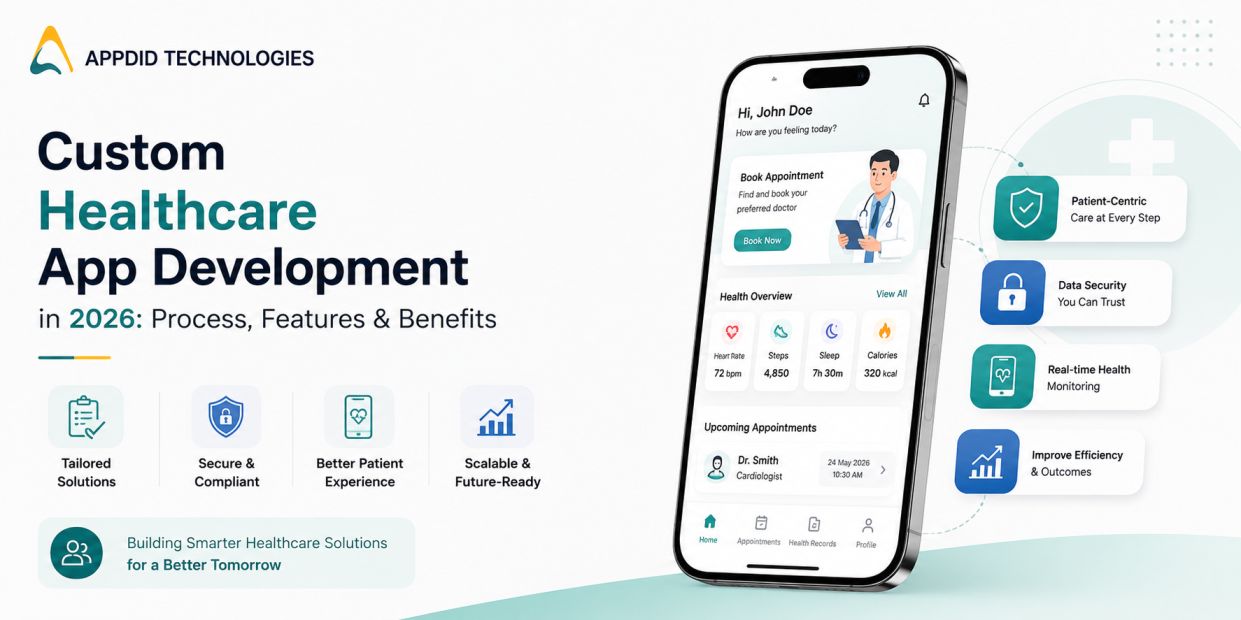
Custom Healthcare App Development in 2026: Process, Features & Benefits
Healthcare is becoming increasingly connected through mobile technology. Patients can book appointments, consult doctors remotely, access medical records, track health data, order medicines, and receive follow-up reminders through mobile applications.
However, healthcare applications have requirements that are very different from standard consumer apps. They often involve sensitive patient information, multiple user roles, healthcare workflows, third-party integrations, and strict security requirements.
This is where custom healthcare app development becomes valuable. Instead of adapting a healthcare business to a generic application, a custom solution can be designed around its specific services, workflows, users, and technology requirements.
In this guide, we'll look at the healthcare app development process, important features, benefits, security considerations, and technologies businesses should consider in 2026.
What Is Custom Healthcare App Development?
Custom healthcare app development is the process of designing and developing a healthcare application specifically around the requirements of a healthcare provider, organization, platform, or service.
Unlike generic health applications, custom healthcare applications can be built around specific workflows such as:
-
Patient management
-
Doctor appointments
-
Telemedicine
-
Digital prescriptions
-
Medical records
-
Remote patient monitoring
-
Medicine delivery
-
Health tracking
-
Diagnostic services
-
Insurance management
For a broader understanding of the healthcare technology landscape, you can also read our guide to custom healthcare mobile app development.
Why Is Custom Healthcare App Development Important in 2026?
Healthcare users increasingly expect digital access to services without compromising privacy or convenience.
A well-planned healthcare application can connect patients, doctors, administrators, laboratories, pharmacies, and other stakeholders through one digital ecosystem.
For example, a healthcare platform could allow a patient to book an appointment, complete a video consultation, receive a prescription, and access their medical information from the same application.
The exact functionality depends on the healthcare business model and its users.
Types of Healthcare Apps Businesses Can Develop
There isn't one standard type of healthcare application. Some common categories include:
Telemedicine Apps
These applications allow patients to connect with healthcare professionals through video, audio, or chat consultations.
Hospital Management Apps
These can help manage patients, appointments, doctors, departments, billing, and administrative workflows.
Patient Engagement Apps
These focus on appointments, reminders, prescriptions, health information, communication, and patient education.
Remote Patient Monitoring Apps
These applications can collect health information from connected devices and present relevant information to patients or healthcare professionals.
Medicine Delivery Apps
These allow users to search for medicines, upload prescriptions, place orders, make payments, and track deliveries.
For more information, see our complete guide to building a medicine delivery app.
Wellness and Health Tracking Apps
These applications can track areas such as physical activity, nutrition, sleep, and other lifestyle information.
Key Features of a Custom Healthcare App
The features should be determined by the application's purpose rather than simply adding every available healthcare feature.
1. User Registration and Profiles
Users should be able to securely create accounts and maintain relevant personal information.
Different profiles can be created for:
-
Patients
-
Doctors
-
Nurses
-
Administrators
-
Pharmacists
-
Other healthcare professionals
2. Appointment Management
Patients can search for available healthcare professionals, select appointment slots, and receive reminders.
Healthcare providers can manage their schedules and appointments through their own interface.
3. Telemedicine
Video consultations, audio calls, secure messaging, and digital consultation workflows can allow healthcare providers to offer remote services.
4. Electronic Health Records
Healthcare applications can provide authorized users with access to relevant medical information, test reports, prescriptions, and treatment history.
EHR integration should be carefully planned because healthcare data requires appropriate security and access controls.
5. Prescription Management
Applications can allow doctors to create digital prescriptions while patients can securely access and manage them.
6. Health Monitoring
Healthcare apps can connect with compatible devices or manually entered information to help users track health metrics.
7. Notifications and Reminders
Push notifications can be used for:
-
Appointment reminders
-
Medication reminders
-
Prescription updates
-
Consultation notifications
-
Follow-up reminders
-
Health alerts
8. Secure Communication
Chat and messaging functionality can help patients communicate with healthcare professionals while maintaining appropriate security measures.
9. Admin Dashboard
An administrative dashboard provides centralized control over users, appointments, healthcare professionals, reports, content, and other operational functions.
10. AI-Powered Features
AI can be considered for use cases such as:
-
Health information assistants
-
Symptom assessment support
-
Personalized recommendations
-
Patient engagement
-
Medical document processing
-
Predictive analytics
AI should be implemented according to the application's actual purpose and regulatory requirements rather than simply adding it as a feature.
You can also explore our article on AI in mobile applications to understand how AI can be incorporated into modern mobile products.
Custom Healthcare App Development Process
Building a healthcare application requires more planning than simply designing screens and writing code.
1. Requirement Analysis
The first step is understanding:
-
Target users
-
Healthcare services
-
Business workflows
-
Required platforms
-
Data requirements
-
Integrations
-
Security requirements
This helps define the actual scope of the application.
2. UI/UX Design
Healthcare applications should prioritize simplicity and accessibility.
Patients may include elderly users or people with different accessibility needs, so navigation, typography, forms, and interactions should be carefully designed.
Our article on essential healthcare app features covers several design and functionality considerations for healthcare applications.
3. Technology Planning
The development team selects appropriate technologies based on the application's requirements.
This can include:
-
Android
-
iOS
-
Flutter
-
React Native
-
Backend frameworks
-
Cloud infrastructure
-
Databases
-
APIs
For applications requiring native iPhone experiences, iOS App Development Services can be considered alongside the overall healthcare architecture.
4. Backend Development
The backend handles important functions such as authentication, user management, medical information, appointments, notifications, APIs, and integrations.
A strong backend architecture is essential for applications expected to handle sensitive healthcare information and growing user volumes.
5. API and Third-Party Integration
Healthcare applications frequently need to connect with external systems.
Depending on the project, integrations may include:
-
EHR systems
-
Payment gateways
-
Wearables
-
Video consultation services
-
SMS and OTP providers
-
Pharmacy systems
-
Laboratory systems
-
Analytics platforms
6. Testing and Security
Healthcare applications require extensive testing across functionality, performance, security, usability, and different devices.
Security should be considered throughout development rather than only before launch.
7. Deployment and Maintenance
After launch, the application needs regular monitoring, updates, bug fixes, security improvements, and compatibility updates as operating systems and third-party services evolve.
For a detailed overview of the development journey, see our beginner's guide to healthcare app development.
Security and Compliance in Healthcare Apps
Healthcare applications deal with sensitive information, making security one of their most important considerations.
Depending on the application's market and functionality, businesses may need to consider applicable privacy and healthcare regulations.
Important technical measures can include:
-
Encryption
-
Secure authentication
-
Role-based access
-
API security
-
Access controls
-
Audit logs
-
Secure data storage
-
Regular security testing
-
Backup and recovery mechanisms
The exact compliance requirements depend on where the application operates, what information it handles, and what services it provides.
Benefits of Custom Healthcare Apps
Better Patient Experience
Patients can access relevant services from a single application instead of relying on multiple disconnected systems.
Improved Operational Efficiency
Automation can reduce repetitive administrative work and streamline workflows.
Personalized Healthcare Experiences
Custom applications can provide experiences based on user roles, preferences, health information, and service requirements.
Better Communication
Patients and healthcare professionals can communicate through integrated messaging, notifications, and telemedicine functionality.
Scalable Architecture
A custom application can be designed around anticipated business growth instead of being restricted to the capabilities of a generic platform.
Greater Control
Businesses have greater control over workflows, functionality, integrations, branding, and future development.
How AI and IoT Are Shaping Healthcare Apps
Healthcare applications are increasingly moving beyond basic appointment and communication functionality.
AI can support intelligent workflows, while IoT and wearable integrations can enable applications to work with real-time health information.
For example, remote monitoring platforms can connect with compatible devices and present relevant information through mobile dashboards.
Businesses interested in this area can explore our AI Remote Patient Monitoring article for a deeper look at this application model.
Native vs Cross-Platform Healthcare Apps
Businesses developing healthcare applications also need to decide whether to build separate native applications or use a cross-platform approach.
Native development can provide deeper platform-specific capabilities, while cross-platform development can allow teams to share more of their code across Android and iOS.
The right choice depends on:
-
Required device capabilities
-
Application complexity
-
Performance requirements
-
Development strategy
-
Target audience
-
Long-term maintenance
For projects requiring both platforms, cross-platform mobile app development can be evaluated as an option.
Why Choose Appdid for Healthcare App Development?
Appdid develops custom healthcare applications designed around specific business and user requirements.
Our healthcare technology work includes solutions involving patient management, digital healthcare services, remote monitoring, wellness, consultations, and other healthcare workflows. Our healthcare app development capabilities focus on scalable architecture, user-centric design, security, integrations, and long-term maintainability.
We also work with businesses across different locations and industries, combining mobile development, backend engineering, APIs, cloud technologies, and modern application architectures.
You can explore Appdid's services to see the broader technology solutions we provide.
What Should You Consider Before Building a Healthcare App?
Before development begins, businesses should clearly define:
-
Who will use the application?
-
What healthcare problem does it solve?
-
Which workflows need to be digitized?
-
What data will the application collect?
-
Which third-party systems need integration?
-
Which platforms should be supported?
-
What security and regulatory requirements apply?
-
How will the application scale?
-
What functionality should be included in the first release?
-
How will the application be maintained after launch?
Answering these questions early can prevent unnecessary development work and help create a more focused product.
Conclusion
Custom healthcare app development allows healthcare organizations to create digital experiences around their own workflows rather than adapting to a generic application.
From telemedicine and appointment management to EHR integration, remote monitoring, digital prescriptions, AI, and wearable connectivity, modern healthcare applications can support a wide range of use cases.
However, successful healthcare development requires more than adding features. Security, accessibility, usability, scalability, integrations, and regulatory requirements need to be considered from the beginning.
Appdid – Healthcare App Development Company
Appdid is a mobile app development company helping businesses build custom healthcare applications using modern technologies and scalable architectures.
Our team works on healthcare platforms, patient-focused applications, remote monitoring solutions, wellness products, and other digital healthcare solutions tailored to specific requirements.
If you're planning a healthcare application, our team can help you define the right features, technology architecture, integrations, and development approach for your project.
Explore our healthcare app development solutions or contact Appdid to discuss your requirements.
Frequently Asked Questions
What is custom healthcare app development?
Custom healthcare app development is the process of building a healthcare application around the specific workflows, users, security requirements, and services of a healthcare organization or business.
What features should a healthcare app have?
Common features include appointment booking, patient profiles, telemedicine, medical records, prescriptions, notifications, secure communication, health tracking, and administrative dashboards. The exact features depend on the application's purpose.
How important is security in healthcare app development?
Security is critical because healthcare applications can process sensitive personal and medical information. Authentication, encryption, access controls, secure APIs, and appropriate compliance measures should be considered during development.
Can healthcare apps use AI?
Yes. AI can support use cases such as virtual assistants, health information processing, personalized recommendations, remote monitoring, and predictive analytics, depending on the application's purpose and applicable regulations.
Can a healthcare app integrate with wearable devices?
Yes. Healthcare applications can be designed to integrate with compatible wearables and connected devices to collect and display relevant health information.
Should a healthcare app be built for Android and iOS?
This depends on the target audience and business requirements. Supporting both platforms can provide broader reach, while the choice between native and cross-platform development should be based on functionality, performance, and maintenance requirements.
Why choose Appdid for custom healthcare app development?
Appdid combines mobile development, backend engineering, API integration, cloud technologies, and healthcare-focused application experience to build scalable digital solutions tailored to specific business requirements.