
Best CRM Software Development Company in Mumbai 2026
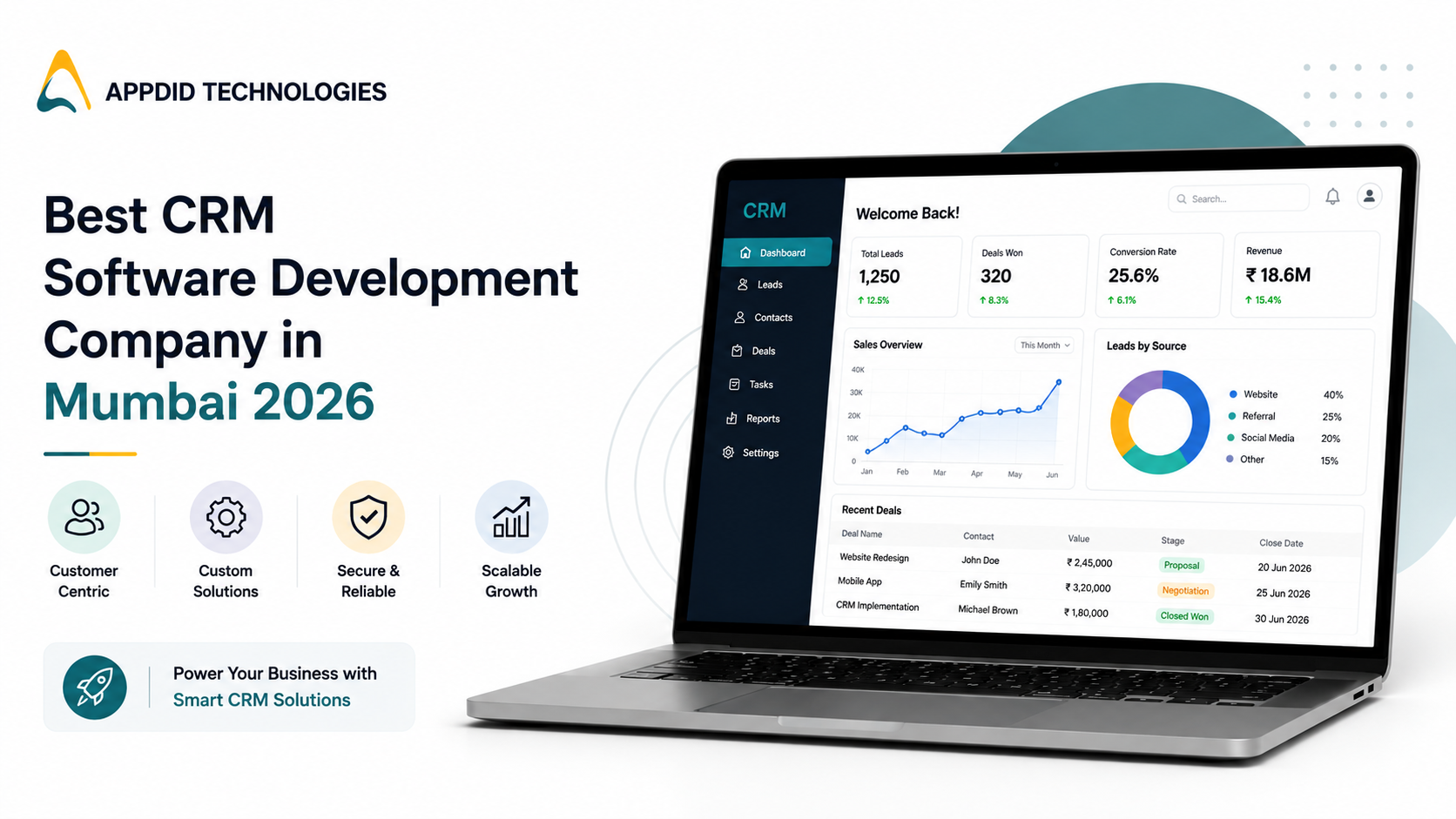
Best CRM Software Development Company in Mumbai 2026
Choosing the right CRM Software Development Company is an important decision for businesses that want to improve customer management, sales processes, communication, and operational efficiency. But with many CRM providers and development companies available, the "best" option depends on what your business actually needs.
If you're searching for a CRM Software Development Company in Mumbai in 2026, you should look beyond a simple list of features. The right solution should fit your existing workflows, integrate with your other systems, scale with your business, and make information easier for teams to use.
This guide looks at what businesses should consider when choosing a CRM development partner in Mumbai and why Appdid is one company worth considering.
What Is CRM Software Development?
CRM software development is the process of designing and building a customer relationship management system around the specific requirements of a business.
Instead of forcing a company to adapt its processes to an off-the-shelf CRM, custom CRM development can create workflows around how the business actually operates.
A CRM application can bring areas such as:
-
Customer information
-
Leads and opportunities
-
Sales pipelines
-
Communication history
-
Task management
-
Follow-ups
-
Reports and analytics
-
Marketing activities
-
Customer support
into one centralized system.
If you're still researching the fundamentals, our guide on CRM Software Development Core Elements explains the major components that make up a modern CRM.
Why Businesses Are Looking at Custom CRM Development in 2026
Businesses today collect customer information from multiple sources. Leads may come from websites, social media, advertisements, email campaigns, phone calls, or third-party platforms.
Without a centralized system, this information can become fragmented.
A well-designed CRM can help teams understand:
-
Who the customer is
-
Where a lead came from
-
Which stage of the sales process they're in
-
What communication has already taken place
-
What action needs to happen next
This is one of the main reasons businesses invest in CRM development rather than relying entirely on spreadsheets or disconnected tools.
What Should You Look for in a CRM Development Company?
If you're comparing CRM companies in Mumbai, don't select a provider only because it offers the largest number of features.
Consider these factors instead.
1. Understanding of Your Business Process
A good CRM development partner should first understand how your sales, marketing, support, and operations teams work.
The CRM should support your workflow rather than make employees change everything just to use the software.
2. Customization Capabilities
Different businesses have different requirements.
A real estate company may need property and lead management, while a service business may prioritize inquiries, appointments, and customer support.
This is where custom CRM software development can be more useful than a one-size-fits-all solution.
3. Integration Experience
A CRM rarely works in isolation.
Your system may need to connect with:
-
Websites
-
Mobile applications
-
Email platforms
-
Payment gateways
-
Accounting software
-
Marketing platforms
-
Communication tools
-
ERP systems
-
APIs
Strong integration capabilities are therefore an important consideration when evaluating a CRM Software Development Company.
4. Scalability
Your CRM should be able to handle increasing customers, employees, data, and workflows.
A scalable architecture helps businesses add new functionality without rebuilding the entire system.
5. Security
CRM systems contain valuable customer and business information.
A development partner should consider:
-
User authentication
-
Role-based access
-
Data encryption
-
Secure APIs
-
Access controls
-
Backup strategies
-
Activity monitoring
Security should be considered during CRM product development rather than added after deployment.
Custom CRM vs Ready-Made CRM
There isn't one CRM solution that is perfect for every business.
Ready-made CRM platforms can be useful when you need standard sales and customer management features and want to start quickly.
Custom CRM software development becomes more attractive when you need specific workflows, integrations, reporting structures, or industry-specific functionality.
|
Factor |
Ready-Made CRM |
Custom CRM |
|
Setup |
Usually faster |
Requires development |
|
Customization |
Limited to available options |
Highly customizable |
|
Integrations |
Depends on platform |
Built around requirements |
|
Workflow |
Standardized |
Business-specific |
|
Scalability |
Platform-dependent |
Architecture can be planned for growth |
|
Ownership |
Depends on provider |
Greater control over solution |
The right choice depends on your budget, processes, technical requirements, and long-term goals.
Cloud CRM or Custom CRM: What Should You Choose?
Cloud-based CRM platforms have become popular because they can be accessed from different locations and devices without requiring businesses to maintain all infrastructure themselves.
They can be particularly useful for distributed sales and support teams.
If you're considering a cloud solution, our article on Cloud-Based CRM for Small Businesses covers the benefits and considerations in more detail.
However, businesses with complex workflows may still benefit from a customized cloud CRM designed around their operational requirements.
Features That Matter in a Modern CRM
A CRM doesn't need hundreds of features to be useful. It needs the right features for its users.
Important capabilities can include:
Lead Management
Capture, organize, assign, and track leads throughout the sales journey.
Contact Management
Maintain customer profiles, interaction history, notes, and related activities in one place.
Sales Pipeline
Give sales teams a clear view of opportunities and their current stages.
Task and Follow-Up Management
Help teams schedule calls, meetings, reminders, and follow-ups.
Reporting and Analytics
Provide insights into sales performance, lead sources, conversion rates, and customer activity.
Automation
Automate repetitive workflows such as lead assignment, notifications, follow-ups, and status updates.
Mobile Access
Sales and field teams can access important customer information while working away from the office.
AI-Powered Capabilities
In 2026, businesses can also consider AI for:
-
Lead scoring
-
Customer insights
-
Sales forecasting
-
Automated summaries
-
Personalized communication
-
Recommendation systems
The goal should be to use AI where it solves a real business problem rather than adding AI simply because it is trending.
Why Use a CRM?
One of the biggest CRM benefits for business is having a centralized view of customer relationships.
A properly implemented CRM can help businesses:
-
Reduce scattered customer information
-
Improve follow-up consistency
-
Increase sales visibility
-
Improve team collaboration
-
Automate repetitive tasks
-
Understand customer behavior
-
Make data-driven decisions
The real value comes from how effectively employees use the system, not simply from having CRM software installed.
Appdid as a CRM Development Partner in Mumbai
Appdid is a technology company that develops custom software and mobile applications for businesses across India.
Our experience in software development allows us to approach CRM projects from both the business and technical perspective. Instead of treating CRM as simply a dashboard, we consider workflows, integrations, user roles, scalability, APIs, databases, and the platforms employees will use.
Businesses looking specifically for local expertise can explore Appdid's CRM Software Development Company in Mumbai page to understand our approach and capabilities.
Our CRM-related development work can involve custom workflows, third-party integrations, dashboards, automation, APIs, and mobile access depending on the project requirements.
How to Choose the Best CRM Software Development Company in Mumbai
Before making a final decision, ask potential development partners:
-
Have you developed CRM systems before?
-
Can the CRM be customized around our workflow?
-
Which third-party systems can you integrate?
-
How will customer data be secured?
-
Can the platform scale as our business grows?
-
Will the CRM support web and mobile access?
-
What happens after the CRM is launched?
-
Can you provide ongoing maintenance and improvements?
The answers will tell you much more than a generic list of CRM features.
Final Thoughts
The best CRM Software Development Company in Mumbai isn't necessarily the company offering the longest feature list. It is the development partner that understands your business processes and can turn them into a secure, usable, and scalable CRM system.
Before choosing between ready-made CRM software and custom development, evaluate your workflows, integrations, users, data requirements, and long-term goals.
For businesses with specialized processes or plans to build a CRM around their own operations, custom CRM development can provide greater flexibility and control.
Looking to Build a Custom CRM?
If you're evaluating CRM development options in 2026, start by defining what your teams need from the system rather than simply copying features from existing CRM platforms.
Appdid can help you evaluate the requirements, choose an appropriate technology approach, and develop a scalable CRM solution around your business processes.
Explore our CRM Software Development Services or contact our team to discuss your requirements.
Frequently Asked Questions
What is CRM software development?
CRM software development is the process of designing and building a customer relationship management system according to a business's specific workflows, users, integrations, and operational requirements.
Why use a CRM for business?
A CRM helps businesses centralize customer information, manage leads, track sales activities, automate workflows, improve follow-ups, and gain better visibility into customer relationships.
Is custom CRM development better than ready-made CRM software?
It depends on the business. Ready-made CRM platforms can work well for standard requirements, while custom CRM development is useful when a business needs specialized workflows, integrations, or greater control over functionality.
How long does CRM software development take?
The timeline depends on the number of features, integrations, user roles, platforms, complexity, and customization required. A basic CRM can be developed faster than a large enterprise CRM with multiple integrations.
What features should a CRM have in 2026?
Important CRM capabilities include lead management, contact management, sales pipelines, automation, reporting, mobile access, integrations, security, and increasingly AI-powered features such as lead scoring and sales insights.
Can Appdid develop custom CRM software?
Yes. Appdid develops custom CRM and software solutions based on business requirements, including workflows, dashboards, integrations, APIs, automation, and mobile accessibility.