
App Development Cost Mumbai: Complete Cost Guide 2026
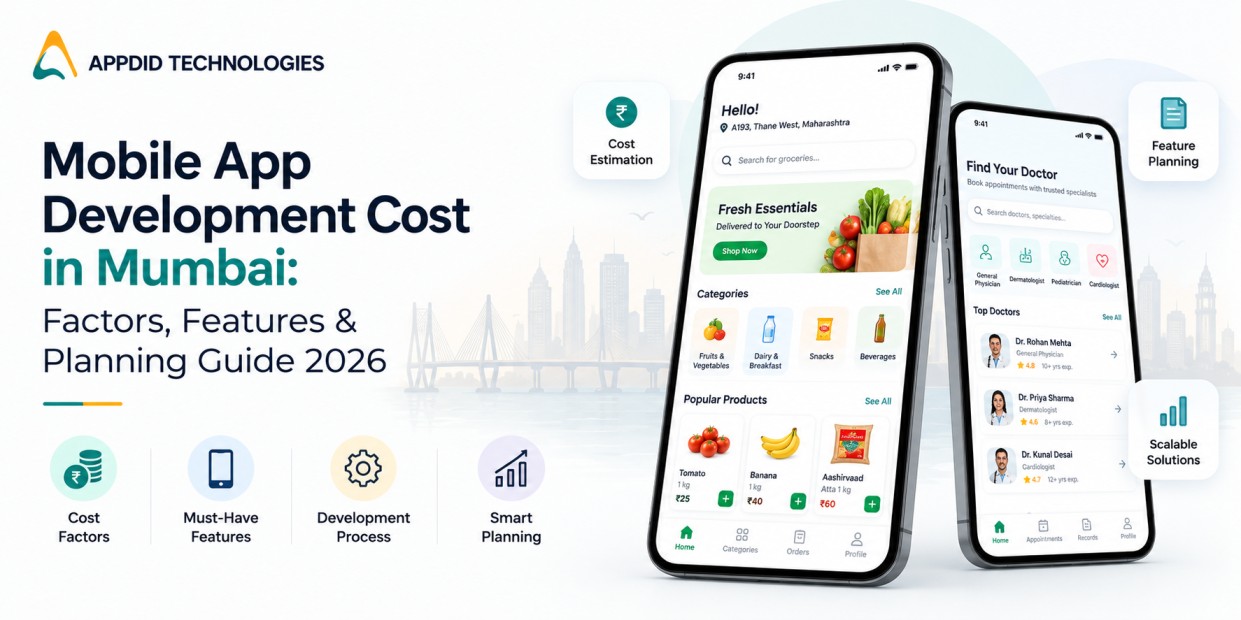
Mobile App Development Cost in Mumbai: Factors, Features & Planning Guide 2026
If you are planning to build a mobile application for your business, one of the first questions you will probably ask is: What is the app development cost in Mumbai?
The answer is not a single fixed number.
A simple business application, an eCommerce platform, a healthcare app, a logistics application and a complex enterprise system can all require very different budgets. The final cost depends on the app's features, platform, UI/UX requirements, backend architecture, integrations, security requirements and development approach.
For businesses looking for mobile app development in Mumbai, understanding these factors before starting development can make budgeting much easier.
Mumbai is also surrounded by major industrial and commercial clusters such as Andheri MIDC, Wagle Estate, TTC Industrial Area, Mahape, Rabale, Turbhe, Taloja, Bhiwandi, Vasai and Panvel. Businesses operating in manufacturing, engineering, pharmaceuticals, chemicals, logistics, food processing and other sectors can use mobile applications for field operations, internal workflows, customer services, sales and supply-chain management.
What Determines App Development Cost in Mumbai?
The cost of building an app depends on much more than the number of screens.
Before approaching an app development company in Mumbai, it helps to break the project into different cost components.
1. Type of Mobile Application
The first factor is the type of application you want to build.
For example:
-
Business and corporate apps
-
eCommerce applications
-
Food delivery apps
-
Healthcare applications
-
CRM applications
-
Logistics and tracking apps
-
Service-provider applications
-
Employee or field-force apps
-
Manufacturing applications
-
Education and training apps
A basic information-based application may require relatively straightforward functionality, while a platform involving multiple users, payments, real-time tracking and complex workflows will require considerably more development work.
If you are still deciding what type of application fits your business, understanding what a mobile application is and how it works can help you define the project more clearly.
2. Android, iOS or Cross-Platform Development
Your choice of platform directly affects development requirements.
Android
Android applications can target a wide range of devices and screen sizes. Businesses targeting a broad Indian audience may prioritise Android development.
You can explore Android app development in Mumbai if Android is your primary platform.
iOS
iOS development is generally chosen when the target audience uses Apple devices or when the application requires a dedicated iOS experience.
For businesses targeting Apple users, iOS app development in Mumbai can be considered as part of the technology strategy.
Cross-Platform
Cross-platform development allows businesses to build applications for multiple platforms using a shared codebase.
This can be useful when you want to launch on Android and iOS while maintaining a more unified development approach. However, whether it is the right option depends on the application's functionality.
Our guide on native vs cross-platform app development explains the major differences.
3. App Features and Functionality
Features are one of the biggest contributors to app development cost.
A basic application may include:
-
User registration
-
Login
-
Profile management
-
Push notifications
-
Basic search
-
Contact forms
-
Dashboard
More advanced applications may require:
-
Online payments
-
GPS and live tracking
-
Real-time chat
-
Video calling
-
AI features
-
Multiple user roles
-
Advanced analytics
-
API integrations
-
Subscription management
-
Document management
-
Automated workflows
-
Admin dashboards
For example, a logistics company may need GPS tracking and delivery management, while a manufacturing company may need inventory, production, purchase and field-service workflows.
So instead of asking only "How much does an app cost?", it is better to ask "What does my business actually need the app to do?"
4. UI/UX Design
Design also contributes to the overall app development cost in Mumbai.
The process may include:
-
User research
-
User flow planning
-
Wireframes
-
Visual design
-
Interactive prototypes
-
Design system
-
Usability testing
A simple internal business application may not need highly elaborate visual design.
On the other hand, consumer-facing applications often need a polished interface because users compare their experience with established apps.
Good UI/UX is not simply about making an app look attractive. It should make important actions easier to find and reduce unnecessary steps.
5. Backend Development
The mobile application is only one part of the system.
Most business applications also require a backend to handle:
-
User accounts
-
Data storage
-
Authentication
-
Business logic
-
Notifications
-
Payments
-
APIs
-
Reports
-
Admin controls
-
Security
-
Third-party integrations
For example, a field-sales application used by a company in Wagle Estate or Andheri MIDC may need to connect sales representatives, managers, customers and the company's internal database.
This means the backend architecture needs to be planned alongside the mobile application rather than treated as an afterthought.
6. Third-Party API Integrations
Integrations can significantly affect the overall development effort.
Depending on the application, businesses may need integrations with:
-
Payment gateways
-
Maps and location services
-
SMS providers
-
Email services
-
CRM systems
-
ERP systems
-
Accounting software
-
Cloud services
-
WhatsApp or communication platforms
-
Analytics platforms
For businesses with existing software systems, API integration can be particularly important.
Our guide on API integration in mobile app development explains why integration planning should happen early in the project.
7. Admin Panel
Many businesses focus heavily on the mobile application and forget about the administration side.
An admin panel may allow your team to:
-
Manage users
-
Add or edit products
-
Manage orders
-
Monitor transactions
-
View reports
-
Manage content
-
Track employees
-
Handle customer requests
-
Configure notifications
For example, a manufacturer in Taloja, TTC or Mahape may require an internal dashboard to monitor field teams, service requests, inventory or customer interactions.
The complexity of this dashboard can therefore influence the total project cost.
App Development Requirements for Mumbai's Industrial Businesses
The app development requirement can look very different for a company operating in an industrial area compared with a consumer-facing business.
Mumbai and its surrounding industrial belt includes areas such as Andheri/Marol, Wagle Estate, TTC, Mahape, Rabale, Turbhe and Taloja, with industries spanning engineering, chemicals, pharmaceuticals, food processing, electronics and other sectors.
For these businesses, mobile applications can support practical operational requirements.
Manufacturing Companies
A manufacturing company may use an application for:
-
Production monitoring
-
Employee attendance
-
Inventory management
-
Quality checks
-
Machine maintenance
-
Purchase requests
-
Sales orders
-
Dealer management
Pharmaceutical and Chemical Businesses
Companies operating around Mumbai and Navi Mumbai's industrial clusters may need applications for:
-
Field sales
-
Distributor management
-
Product catalogues
-
Customer enquiries
-
Order management
-
Compliance-related workflows
-
Service requests
Engineering Companies
Engineering and industrial equipment companies can use mobile applications for:
-
Site visits
-
Service requests
-
Technician assignments
-
Equipment maintenance
-
Customer history
-
Quotation management
-
Spare-parts tracking
Logistics and Warehousing Businesses
Businesses operating around Bhiwandi, Panvel, Taloja and Navi Mumbai can benefit from applications involving:
-
Delivery tracking
-
Driver management
-
Warehouse operations
-
Shipment updates
-
Proof of delivery
-
Route management
-
Customer notifications
For businesses with complex workflows, a custom mobile app development approach can be more suitable than trying to force existing processes into a generic application.
Hidden Costs Businesses Should Consider
The initial development budget is not always the entire cost of owning an application.
Businesses should also consider:
Maintenance
After launch, the application may need updates, bug fixes and technical maintenance.
Server and Cloud Infrastructure
Backend-heavy applications require infrastructure for storing and processing data.
Cloud services can also make it easier to scale applications as usage increases. Businesses can learn more about this through our guide to the benefits of cloud integration.
Security Updates
Applications need ongoing security improvements, especially when handling sensitive customer or business information.
Third-Party Services
Payment gateways, SMS, maps, email systems and other services may have their own usage-based charges.
Future Features
Your initial application may launch with a focused feature set and gradually expand based on customer feedback and business requirements.
Planning for future scalability from the beginning can prevent expensive redevelopment later.
How to Reduce App Development Cost Without Cutting Quality
Reducing cost does not necessarily mean removing important functionality.
A better approach is to prioritise.
Start With the Core Business Problem
Identify the most important problem the application needs to solve.
Prioritise Features
Separate features into:
-
Must-have
-
Important
-
Future
-
Optional
Choose the Platform Strategically
If your target audience is primarily Android users, you may not need to launch on every platform immediately.
Similarly, cross-platform development can be evaluated when both Android and iOS are required.
Reuse Existing Systems
If your business already has an ERP, CRM or database, integrations may be more practical than rebuilding everything from scratch.
Design for Scalability
A low-cost architecture that cannot handle future users can become expensive later.
How to Choose an App Development Company in Mumbai
The lowest quotation is not always the best option.
Before selecting an app development company in Mumbai, look at:
-
Relevant industry experience
-
Previous application projects
-
Technology expertise
-
UI/UX capabilities
-
Backend development experience
-
API integration capabilities
-
Testing process
-
Post-launch support
-
Communication process
-
Understanding of your business requirements
You can also review an agency's previous work through its mobile app development portfolio.
For businesses around Thane, Wagle Estate, Navi Mumbai, Andheri, Taloja, Bhiwandi and other Mumbai-region industrial clusters, local business understanding can also make requirement discussions easier.
Why Appdid for Mobile App Development?
Appdid Technologies works with businesses to plan, design and develop custom mobile applications based on their specific requirements.
Instead of starting with a fixed feature package, the development approach can be aligned with the business model, users, workflows, integrations and long-term requirements.
This can be particularly useful for businesses that need applications beyond standard consumer features — such as manufacturing, industrial services, logistics, healthcare, eCommerce, CRM and field operations.
You can explore Appdid's mobile app development services to understand the broader capabilities available.
If you already have an app idea or an existing business process that you want to digitise, you can contact Appdid to discuss the requirements and determine the right development approach.
Final Thoughts
There is no universal app development cost in Mumbai because every application has different requirements.
The final investment depends on factors such as:
-
Application type
-
Number of platforms
-
Features
-
UI/UX complexity
-
Backend requirements
-
API integrations
-
Admin panel
-
Security
-
Testing
-
Maintenance
-
Scalability
For a business in Mumbai's commercial or industrial ecosystem, the right approach is to first define the problem, users and required workflows before estimating the development effort.
Whether you operate from Andheri MIDC, Wagle Estate, TTC, Mahape, Rabale, Taloja, Bhiwandi, Vasai, Panvel or elsewhere in the Mumbai region, a properly planned mobile application can help digitise processes, improve visibility and create a more efficient customer or employee experience.
FAQs
1. What is the app development cost in Mumbai?
There is no single cost because the budget depends on features, platforms, design, backend complexity, integrations, security and development requirements.
2. What affects mobile app development cost the most?
Features, platform selection, backend complexity, third-party integrations, UI/UX requirements and the number of user roles generally have a major impact on development effort.
3. Is Android or iOS app development cheaper?
The answer depends on the project. A single-platform application can require less development effort than building and maintaining separate native applications for both Android and iOS.
4. Can industrial companies in Mumbai benefit from mobile apps?
Yes. Manufacturing, engineering, pharmaceutical, chemical, logistics and service businesses can use mobile applications for field operations, inventory, service management, sales, tracking and internal workflows.
5. How should I estimate my app development budget?
Start by defining the target users, business problem, required features, platforms, integrations and expected scale. A development company can then convert these requirements into a more realistic project scope and estimate.