Healthcare App Development Cost in Mumbai 2026
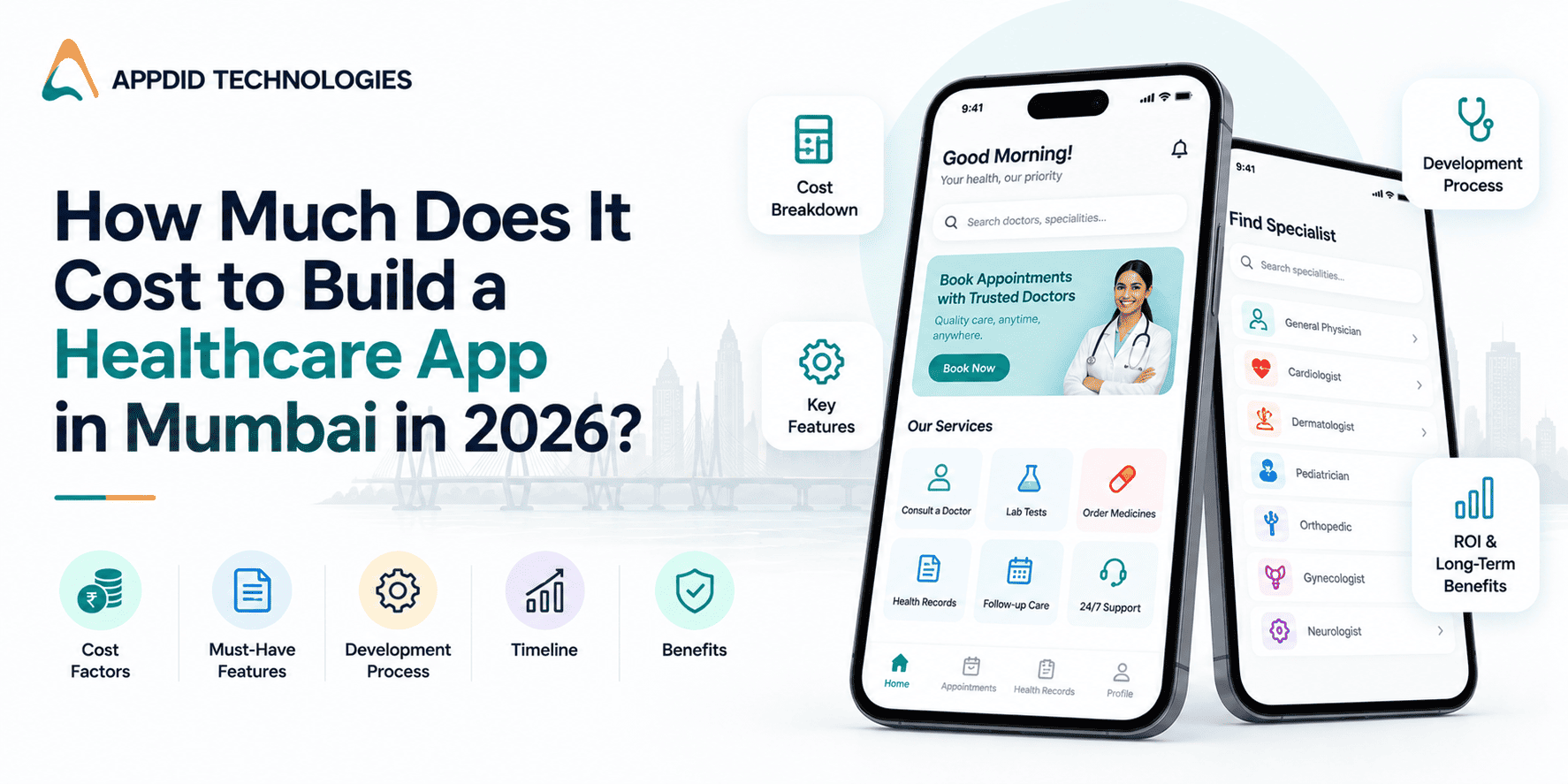
How Much Does It Cost to Build a Healthcare App in Mumbai in 2026?
Healthcare businesses are increasingly adopting mobile applications to improve patient experiences, simplify daily operations, and make healthcare services more accessible. From hospitals and clinics to diagnostic laboratories, pharmacies, and wellness providers, mobile apps help businesses connect with patients and manage services more efficiently.
If you are planning to build a healthcare app in Mumbai, the development cost depends on several factors, including the app's purpose, features, design, technology, integrations, security requirements, and ongoing maintenance. An app designed for appointment booking will have different requirements from a comprehensive healthcare platform that includes pharmacy management, lab test booking, lab management, and mental wellness services.
In this guide, we explain the factors that influence healthcare app development cost in Mumbai, the features businesses should consider, and how to plan a healthcare application that meets their operational needs.
What Factors Affect Healthcare App Development Cost in Mumbai?
Healthcare applications can range from simple patient-facing platforms to complex systems that connect patients, doctors, laboratories, pharmacies, and administrators. Understanding your requirements before development helps you plan the project more effectively.
1. Type of Healthcare Application
The type of application is one of the first factors that influences development effort. Different healthcare businesses require different features, workflows, and integrations.
Common healthcare app types include:
-
Hospital and clinic appointment booking apps
-
Doctor consultation and telemedicine applications
-
Pharmacy management and medicine delivery apps
-
Lab test booking and diagnostic service apps
-
Laboratory management systems
-
Nutrition and diet planning applications
-
Stress management and mental wellness apps
-
Remote patient monitoring applications
-
Integrated healthcare platforms
For example, a clinic appointment booking app may primarily need doctor profiles, available time slots, patient registration, and appointment notifications. A diagnostic platform may require lab test catalogues, home sample collection scheduling, report management, and integration with laboratory systems.
Businesses planning specialised solutions can explore healthcare app development services to understand the different capabilities involved in building healthcare applications.
2. Features and Functional Requirements
The number and complexity of features significantly influence the development process. Each feature requires planning, interface design, development, testing, and sometimes integration with external systems.
A basic application may include patient registration, appointment booking, notifications, and profile management. A more advanced platform may include online consultations, electronic health records, payment processing, pharmacy inventory, laboratory workflows, and analytics.
Before development begins, identify the features that are essential for launch and those that can be introduced in later versions. This approach helps prioritise development effort and avoid unnecessary complexity.
3. Android, iOS, or Cross-Platform Development
Your choice of platform also affects project scope.
An Android application can help businesses reach Android users, while an iOS application serves patients using Apple devices. Developing separate native applications may require platform-specific implementation and testing.
Alternatively, cross-platform development can allow businesses to build applications for multiple platforms using a shared codebase, depending on the requirements.
The right approach depends on the target audience, required device capabilities, performance expectations, and long-term product roadmap. Explore Android app development, iOS app development, and cross-platform app development to compare potential approaches.
4. UI/UX Design and Accessibility
Healthcare applications should be easy to navigate, especially for patients who may not be familiar with digital healthcare services.
The design process may include patient registration screens, appointment calendars, doctor profiles, medicine catalogues, lab test listings, payment interfaces, and health dashboards.
Clear navigation, readable text, accessible controls, and simple booking processes can improve the user experience. The design should also account for different user groups, including patients, doctors, laboratory staff, pharmacists, and administrators.
5. Third-Party Integrations
Healthcare apps often need to connect with external services and existing business systems. These integrations can add development and testing requirements.
Depending on the application, integrations may include:
-
Payment gateways
-
SMS and email notifications
-
Video consultation platforms
-
Maps and location services
-
Pharmacy inventory systems
-
Laboratory information systems
-
Electronic health record platforms
-
Appointment scheduling software
-
Analytics and reporting tools
The complexity depends on the availability, documentation, security requirements, and compatibility of the systems being integrated.
Businesses can also review API integration in mobile app development to understand how applications exchange information with external platforms.
Essential Features to Include in a Healthcare App
Healthcare businesses should select features according to their services, operational workflows, and patient needs. The following features are useful starting points for planning a healthcare application.
1. Appointment Booking and Doctor Scheduling
Appointment booking is one of the most common features in healthcare applications. It allows patients to find doctors, view available time slots, and schedule consultations without relying entirely on phone calls or manual processes.
Useful appointment booking features include:
-
Doctor profiles and specialisations
-
Availability calendars
-
Appointment scheduling and rescheduling
-
Booking confirmations and reminders
-
Cancellation management
-
Patient appointment history
-
Doctor-side scheduling dashboards
-
Online and in-clinic consultation options
For clinics and hospitals, the system should help prevent scheduling conflicts and give authorised staff visibility into appointments.
A well-designed booking process can reduce administrative work while making it easier for patients to access healthcare services.
2. Pharmacy Management
A healthcare application that supports pharmacies may require features for medicine catalogues, inventory tracking, prescription handling, order management, and delivery coordination.
Important pharmacy management capabilities include:
-
Medicine search and categorisation
-
Prescription upload and review workflows
-
Stock and inventory management
-
Batch and expiry-date tracking
-
Order placement and status updates
-
Payment processing
-
Delivery scheduling
-
Reorder alerts for authorised staff
If the application supports online medicine orders, prescription verification and applicable regulatory requirements should be considered during planning.
A pharmacy management system may also need an administrative dashboard for managing product information, stock availability, orders, and customer support.
For businesses combining online ordering with broader digital operations, eCommerce app development can provide useful context for planning catalogues, transactions, and order workflows.
3. Nutrition and Diet Planning
Nutrition apps can support dietitians, nutrition clinics, wellness providers, and individuals who want to manage their eating habits.
Depending on the target audience, a nutrition app may include:
-
User profiles and dietary preferences
-
Meal planning and food diaries
-
Nutrition and calorie tracking
-
Dietitian appointment booking
-
Meal reminders
-
Progress tracking
-
Personalised diet plans
-
Secure communication between users and nutrition professionals
More advanced applications may allow authorised nutrition professionals to create and update diet plans through a dedicated dashboard.
The feature set should reflect the intended service. A simple meal-planning application may not require the same infrastructure as a platform connecting patients with dietitians for ongoing consultations.
4. Stress Management and Mental Wellness
Mental wellness applications can help users access resources for stress management, mindfulness, relaxation, and professional support.
Potential features include:
-
Guided breathing exercises
-
Meditation and mindfulness sessions
-
Mood tracking and journaling
-
Sleep and relaxation resources
-
Mental wellness reminders
-
Counsellor or therapist appointment booking
-
Secure messaging
-
Progress tracking
-
Video consultation integration
Privacy should be a central consideration because users may share sensitive personal information. Access controls, secure storage, clear consent processes, and appropriate data-handling practices should be built into the application.
If the app provides clinical mental health services, its workflows and claims should be designed around the relevant professional and regulatory requirements. Wellness features should not be presented as a substitute for emergency or professional mental healthcare.
5. Lab Test Booking
Lab test booking allows patients to browse available diagnostic tests and schedule appointments for laboratory visits or home sample collection.
Common features include:
-
Test catalogues and descriptions
-
Test preparation instructions
-
Lab location information
-
Home sample collection requests
-
Appointment scheduling
-
Booking confirmations
-
Payment options
-
Sample collection status
-
Digital report access
-
Notifications when reports are available
For diagnostic businesses, a smooth booking process can help patients understand the available tests and choose a suitable appointment.
The app should also clearly communicate any preparation requirements, eligibility conditions, and operational limitations associated with specific tests.
6. Lab Management
Lab management features are particularly important for diagnostic centres that want to manage internal workflows alongside patient bookings.
Depending on the laboratory's operations, the system may include:
-
Patient and test registration
-
Sample collection tracking
-
Sample identification and status updates
-
Test assignment and processing workflows
-
Laboratory staff dashboards
-
Report generation and review
-
Report approval by authorised personnel
-
Equipment or inventory records
-
Billing and payment tracking
-
Operational reports and analytics
A laboratory management system may need to integrate with existing diagnostic equipment or laboratory information systems. The complexity of these integrations should be evaluated before development begins.
It is also important to establish role-based access so that laboratory staff, administrators, and authorised medical professionals can access the information relevant to their responsibilities.
7. Patient Profiles and Medical Records
A patient profile can bring relevant information together in one place. Depending on the app's purpose, it may include personal details, appointment history, prescriptions, diagnostic reports, and other authorised medical information.
The application should collect only the information necessary for its intended purpose and provide appropriate access controls.
Where the application manages sensitive health information, the development team must consider applicable privacy, consent, retention, and security requirements.
8. Notifications and Reminders
Notifications help users stay informed about appointments, consultations, medicine orders, sample collection, and report availability.
Useful notification types include:
-
Appointment confirmations
-
Upcoming appointment reminders
-
Consultation updates
-
Medicine order status
-
Sample collection reminders
-
Lab report availability
-
Prescription or follow-up reminders
Users should have appropriate control over non-essential notifications. Sensitive health information should not be unnecessarily exposed in messages displayed on lock screens or shared devices.
9. Admin Dashboard and Reporting
A healthcare app may require an administrative dashboard to manage users, appointments, services, staff, transactions, and operational data.
For example, a clinic may need to manage doctors and appointments, while a pharmacy may need inventory and order management. A diagnostic laboratory may require sample tracking and report workflows.
The dashboard should be tailored to each business rather than including every possible feature by default.
How Much Does Healthcare App Development Cost in Mumbai Without Fixed Pricing?
There is no single development cost that applies to every healthcare application. The investment depends on the features, integrations, platforms, security requirements, and operational complexity involved.
Instead of relying on a generic estimate, businesses should evaluate the following project components.
Basic Healthcare App
A basic application may focus on a specific requirement, such as appointment booking, doctor information, patient registration, and notifications.
This type of project generally has a narrower scope and fewer integrations than a platform managing multiple healthcare services.
It may suit a clinic or healthcare provider that wants to make appointment scheduling and patient communication more convenient.
Mid-Level Healthcare App
A mid-level application may combine several patient-facing features, such as appointment booking, online consultations, payment integration, patient profiles, and medical report access.
It may also include an administrative dashboard and separate interfaces for patients and healthcare professionals.
The development effort depends on how these features interact and whether the application needs to connect with existing business systems.
Advanced Healthcare Platform
An advanced platform may combine appointment booking, pharmacy management, nutrition services, mental wellness, lab test booking, lab management, and patient records.
Such a platform may require multiple user roles, complex workflows, external integrations, detailed reporting, and stronger security controls.
The main challenge is not simply the number of features. It is ensuring that different services exchange information correctly and operate reliably within the same system.
Factors to Discuss Before Requesting a Proposal
Before requesting a development proposal, prepare information about:
-
The target users and healthcare services
-
Required Android and iOS support
-
Patient-facing and staff-facing features
-
Third-party systems and integrations
-
Data security and privacy requirements
-
Administrative workflows
-
Expected user volumes
-
Maintenance and support expectations
-
Future expansion plans
A clearly defined scope makes it easier to evaluate proposals and compare development approaches on a like-for-like basis.
Healthcare App Development Process
A structured development process helps healthcare businesses identify risks early and manage the project more effectively.
Step 1: Requirement Analysis
The first step is to understand the business model, target users, operational challenges, and expected outcomes.
For example, a diagnostic centre may prioritise lab test booking and sample tracking, while a wellness provider may focus on nutrition planning and mental wellness features.
The requirements should be documented before detailed design and development begin.
Step 2: Feature Planning and Prototyping
Once the requirements are clear, the team defines the application structure, user journeys, permissions, and key workflows.
Wireframes and prototypes help stakeholders review the experience before development progresses. This is particularly useful when the application includes multiple roles, such as patients, doctors, pharmacists, and laboratory staff.
Step 3: UI/UX Design and Development
The design team develops the interface, while the development team builds the application, backend, database, and administrative tools.
Depending on the project, the backend may manage user accounts, appointments, notifications, payments, medical records, and integrations.
Businesses should select a technology approach that supports their current requirements and anticipated growth.
Step 4: Integration and Security Implementation
The development team connects the application to required external services and configures appropriate security measures.
These may include encrypted data transmission, secure authentication, role-based permissions, access logging, and appropriate data-protection controls.
For additional context, read why encryption is important for app developers.
Step 5: Testing and Quality Assurance
Healthcare applications require thorough testing because errors can disrupt appointments, transactions, access to reports, and other important workflows.
Testing should cover:
-
Registration and authentication
-
Appointment booking and cancellation
-
Pharmacy orders and inventory updates
-
Lab test booking and sample status
-
Report access and permissions
-
Payment and notification workflows
-
API integrations
-
Device and operating system compatibility
-
Performance and security
The testing process should also verify that sensitive information is accessible only to authorised users.
Step 6: Deployment and Ongoing Maintenance
After testing and approval, the application can be prepared for release.
Post-launch work may include bug fixes, operating system compatibility updates, security patches, performance monitoring, and new features. Maintenance requirements should be considered during initial project planning rather than after launch.
Healthcare App Security and Compliance Considerations
Healthcare applications may process sensitive personal and medical information, making privacy and security essential from the beginning.
Businesses should consider the following areas during planning:
-
Secure authentication and appropriate access permissions
-
Encryption for data in transit and, where appropriate, at rest
-
Secure API communication
-
Data minimisation and purpose limitation
-
Consent and privacy notices
-
Secure backups and recovery procedures
-
Audit logs for sensitive operations
-
Data retention and deletion policies
-
Vendor and third-party integration risks
-
Applicable Indian data-protection and healthcare requirements
The exact obligations depend on the nature of the application, the information it handles, the services it provides, and the organisations involved. Businesses should obtain appropriate legal and compliance guidance for their use case.
Security should be considered throughout design, development, testing, deployment, and maintenance rather than treated as a final-stage addition.
How to Choose a Healthcare App Development Company in Mumbai
Selecting the right development partner is an important part of planning a healthcare application. Look beyond the initial proposal and evaluate whether the team understands your business workflows and technical requirements.
Consider the following factors:
Healthcare workflow understanding: The team should understand how appointments, patient records, pharmacy operations, diagnostic bookings, and other relevant processes work.
Technical capabilities: Review the team's experience with mobile applications, backend systems, APIs, databases, dashboards, and third-party integrations.
Security approach: Ask how authentication, permissions, data protection, testing, and maintenance will be handled.
Project communication: Confirm how requirements, milestones, testing feedback, and changes will be managed throughout development.
Portfolio and experience: Review completed projects and discuss how the team's experience relates to your proposed application.
Post-launch support: Clarify the process for maintenance, bug fixes, security updates, and future enhancements.
Appdid Technologies provides mobile application development services for businesses with different operational requirements. You can explore the Appdid portfolio to review project experience and visit the mobile app development services page to learn more about its development capabilities.
For businesses planning a healthcare application, the next step is to define the required features, identify essential integrations, and discuss the project scope with a development team.
Conclusion
The cost of building a healthcare app in Mumbai in 2026 depends on the application's purpose, feature set, platforms, integrations, security requirements, and long-term maintenance needs. An appointment booking application has different requirements from a comprehensive healthcare platform combining pharmacy management, nutrition planning, stress management, mental wellness, lab test booking, and lab management.
The most effective approach is to start with clearly defined business requirements, prioritise essential features, and plan for security, usability, and future expansion from the beginning.
Appdid Technologies can help businesses explore mobile application development approaches based on their requirements. To discuss your project scope and potential technical approach, contact Appdid Technologies.
Frequently Asked Questions
1. What factors affect healthcare app development cost in Mumbai?
The main factors include application complexity, required features, Android and iOS support, UI/UX design, backend development, third-party integrations, security requirements, testing, and ongoing maintenance.
2. Can a single healthcare app include appointment booking, pharmacy management, and lab test booking?
Yes. A healthcare platform can combine these services, provided the requirements and workflows are planned carefully. The application may need separate interfaces and permissions for patients, doctors, pharmacy staff, laboratory staff, and administrators.
3. Can nutrition and mental wellness features be added to a healthcare app?
Yes. Features such as meal planning, nutrition tracking, mindfulness exercises, mood tracking, and wellness consultations can be incorporated based on the application's purpose. Sensitive user information should be protected through appropriate privacy and security controls.
4. How long does it take to develop a healthcare app?
The development timeline depends on the number of features, complexity of integrations, platform requirements, design scope, testing needs, and availability of stakeholders. A focused application generally requires less work than a multi-service healthcare platform.
5. What security features should a healthcare app have?
Depending on the use case, a healthcare app may require secure authentication, role-based access controls, encryption, secure APIs, audit logging, protected backups, consent management, and appropriate data-retention policies. Applicable privacy and healthcare requirements should be assessed before development.