
iOS 27 App Development: What's New for Developers & Businesses?
iOS 27 App Development: What's New for Developers and Businesses?
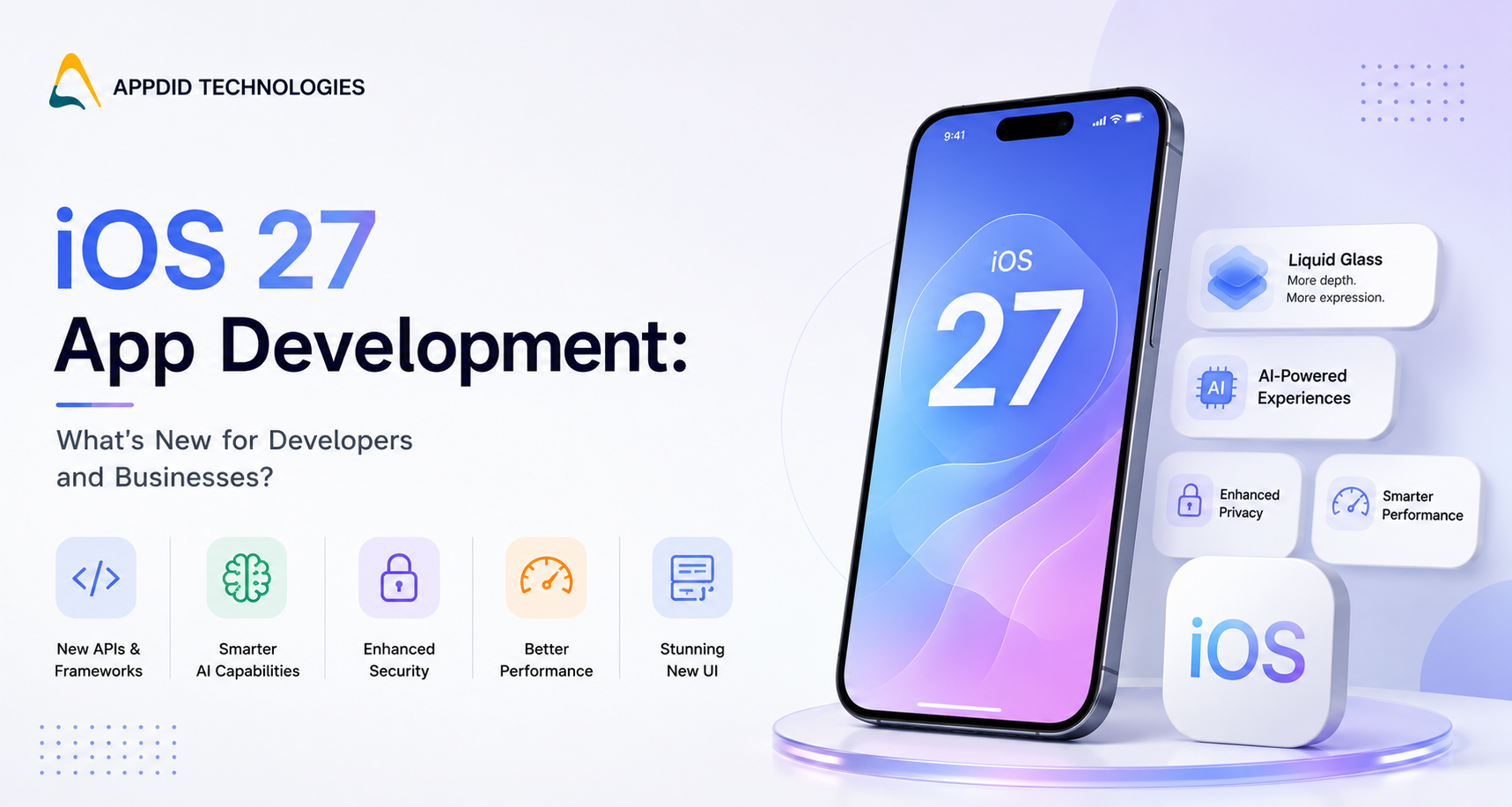
Apple continues to expand the capabilities available to developers with every major iOS release. With iOS 27, the focus is increasingly on on-device intelligence, AI-powered app experiences, improved system integration, modern interface design, and better development workflows.
For businesses planning an iOS application, these changes are more than technical updates. They create new opportunities to build applications that are more intelligent, personalized, responsive, and deeply integrated with the Apple ecosystem.
In this guide, we'll explore the major iOS 27 updates developers and businesses should know about and how they can influence modern mobile app development.
What Is New in iOS 27?
iOS 27 introduces several new technologies and developer capabilities, including:
-
Foundation Models framework
-
Core AI framework
-
Expanded App Intents capabilities
-
Improved Siri integration
-
SwiftUI enhancements
-
UIKit improvements
-
New WidgetKit capabilities
-
Xcode 27 coding intelligence
-
Better testing and development tools
-
New opportunities for on-device AI
These features give developers more options for creating intelligent and highly integrated applications.
1. Foundation Models Framework
One of the biggest developments in iOS 27 is the expanded Foundation Models framework.
Apple provides developers with a native Swift API for working with its on-device foundation models. Applications can use these capabilities to create intelligent experiences without necessarily sending every interaction to an external AI service.
The framework also supports multimodal prompts, allowing applications to work with text and images. Vision tools such as OCR and barcode recognition can also be used by models on-device.
What This Means for Businesses
Businesses can potentially build features such as:
-
AI-powered assistants
-
Intelligent search
-
Document analysis
-
Personalized recommendations
-
Image-based interactions
-
Smart content generation
This creates new possibilities for AI-powered iOS applications while keeping more processing on the device.
2. Core AI for On-Device Intelligence
iOS 27 also introduces Core AI, a framework designed to help developers run their own AI models directly on Apple devices.
Core AI is optimized for Apple silicon and provides developers with tools for running models on-device while controlling memory and inference performance.
For businesses, on-device AI can offer advantages such as:
-
Lower latency
-
Reduced dependence on cloud APIs
-
Better privacy
-
Offline functionality
-
More responsive AI features
This can be particularly useful for applications that process sensitive or frequently changing information.
3. Smarter Siri Integration with App Intents
Apple is making it easier for applications to work with Siri and Apple Intelligence through App Intents.
Apps can expose their content and actions so users can discover and interact with them using natural language. Entity and intent schemas help Siri understand what an application offers and what users can do inside it.
For example, users could potentially interact with an application without manually navigating through multiple screens.
For businesses, this means app functionality can become more accessible through Apple's broader ecosystem.
4. Improved App Intents and Spotlight Discovery
iOS 27 expands how application content can become discoverable through system experiences.
Entity schemas can contribute app content to Spotlight's semantic index, allowing relevant information from an application to surface more naturally.
This can help businesses improve the visibility and accessibility of important app content.
5. SwiftUI Improvements
SwiftUI continues to receive major improvements in iOS 27.
Apple has introduced enhancements for document-based applications, list and grid interactions, lazy loading, and smoother scrolling experiences.
For developers, these improvements can make it easier to create:
-
Responsive interfaces
-
High-performance lists
-
Modern dashboards
-
Document-based applications
-
Adaptive layouts
Businesses benefit from more flexible UI development and better user experiences across Apple devices.
6. UIKit and Interface Improvements
Developers working with UIKit also receive new capabilities in iOS 27.
Apple is introducing layouts that better adapt to experiences such as iPhone Mirroring, while refreshed materials, typography, navigation bars, and other interface elements provide a more unified visual experience.
This means existing applications may need UI reviews to ensure their interfaces remain visually consistent with the latest iOS design direction.
7. Better Widget Experiences
WidgetKit receives additional capabilities in iOS 27, including improved customization through App Intents and dynamic styling.
Businesses can use widgets to bring useful information and actions closer to users without requiring them to open the application every time.
Potential examples include:
-
Order tracking
-
Appointment information
-
Account updates
-
Travel information
-
Productivity tools
-
Real-time status updates
8. Xcode 27 and AI-Assisted Development
iOS 27 development is closely connected with Xcode 27, which introduces expanded coding intelligence and agentic development capabilities.
Developers can work with coding agents that assist with tasks such as generating code, implementing changes, testing features, reviewing visual changes, and interacting with simulators.
This can help development teams reduce repetitive work and spend more time on architecture, product decisions, and user experience.
9. Improved Testing and Development Workflow
Xcode 27 also introduces tools designed to make testing and debugging more efficient.
Device Hub brings devices and simulators together in one place, helping developers reproduce issues and inspect device states more efficiently. Apple has also enhanced performance workflows in Instruments.
For businesses, better testing workflows can contribute to:
-
Faster development cycles
-
Earlier bug detection
-
More reliable releases
-
Better application performance
10. New Opportunities for AI-Powered Apps
The combination of Foundation Models, Core AI, App Intents, and Siri integration makes AI one of the most important themes in iOS 27.
Developers can explore AI-powered functionality while considering whether processing should happen on-device, in the cloud, or through a combination of both.
The right approach depends on factors such as:
-
Data sensitivity
-
Performance requirements
-
AI model complexity
-
Connectivity
-
Infrastructure requirements
-
User experience
Businesses should therefore treat AI as part of application architecture rather than simply adding an AI feature at the end of development.
What Does iOS 27 Mean for Businesses?
For businesses, iOS 27 creates opportunities to improve both existing and new applications.
Some potential benefits include:
Better Personalization
AI and system-level intelligence can help applications deliver more relevant experiences.
Improved User Engagement
Widgets, Siri integration, Spotlight discovery, and App Intents can make application functionality easier to access.
More Private AI Experiences
On-device processing can reduce the need to send certain information to external servers.
Faster Development
AI-assisted tools in Xcode can help developers automate repetitive development tasks.
Better Application Performance
New SwiftUI, UIKit, and system-level improvements give developers more tools for building responsive applications.
Should Existing iOS Apps Be Updated for iOS 27?
Businesses should evaluate their existing applications before deciding how extensively to adopt new iOS 27 capabilities.
An application review can include:
-
UI compatibility
-
API changes
-
Performance
-
Accessibility
-
AI opportunities
-
App Intents integration
-
Widget improvements
-
Testing requirements
Not every application needs every new feature. The right approach is to prioritize updates that provide measurable value to users and the business.
How iOS 27 Can Influence New App Development
For new applications, iOS 27 provides an opportunity to consider modern capabilities from the beginning.
Development teams can plan for:
-
AI-assisted experiences
-
On-device intelligence
-
Siri integration
-
Modern SwiftUI interfaces
-
Widgets
-
Secure authentication
-
Scalable backend architecture
-
Cloud and API integrations
Businesses planning a new iPhone application can explore our iOS App Development Services in Mumbai to understand how a professional development team can approach modern iOS projects.
iOS 27 Development Best Practices
Businesses and development teams should consider the following when adopting iOS 27 technologies:
-
Test applications against the latest SDK.
-
Review existing UI components.
-
Evaluate on-device AI use cases carefully.
-
Protect sensitive user data.
-
Test App Intents and Siri integrations thoroughly.
-
Monitor application performance.
-
Avoid adopting new technologies simply because they are available.
-
Prioritize features based on actual user needs.
Apple's iOS 27 documentation and beta resources should be consulted during implementation because APIs and behaviors can change during the development cycle.
Conclusion
The arrival of iOS 27 represents another major step toward intelligent, connected, and personalized mobile applications.
Foundation Models, Core AI, App Intents, Siri integration, SwiftUI improvements, widgets, and AI-assisted Xcode workflows give developers new ways to build modern applications.
For businesses, the biggest opportunity is not simply upgrading an existing application to iOS 27. It is identifying which of these capabilities can improve customer experience, operational efficiency, personalization, and long-term product value.
Appdid – Expert iOS App Development Company
Appdid is an expert mobile app development company helping businesses build modern Android, iOS, and cross-platform applications using scalable architectures and current development technologies.
Our team works on custom mobile applications, API integrations, cloud solutions, enterprise applications, eCommerce platforms, and AI-powered mobile experiences tailored to specific business requirements.
You can explore our App Development Services in Mumbai to learn more about our approach to building secure and high-performance iOS applications.
Ready to Build a Modern iOS Application?
Whether you're planning a new iPhone application or looking to modernize an existing app, Appdid can help evaluate the right technologies and development approach for your requirements.
-
Build modern iOS applications
-
Integrate AI-powered capabilities
-
Develop secure APIs and backend systems
-
Create scalable and user-focused mobile experiences
Explore our Portfolio to see our work across different industries, or Contact Us to discuss your iOS app development requirements.
Frequently Asked Questions
What is iOS 27?
iOS 27 is Apple's latest major operating system release for iPhone, introducing new AI, developer frameworks, interface improvements, and system-level capabilities.
What are the major iOS 27 features for developers?
Major areas include the Foundation Models framework, Core AI, expanded App Intents, improved Siri integration, SwiftUI enhancements, UIKit improvements, WidgetKit updates, and Xcode 27 development tools.
How does iOS 27 improve AI app development?
Developers can use Foundation Models for on-device AI experiences and Core AI for running their own models on Apple hardware. Apps can also integrate more deeply with Siri and Apple Intelligence through App Intents.
Should businesses upgrade their iOS applications to iOS 27?
Businesses should evaluate their application's compatibility, user requirements, performance, and opportunities for adopting new capabilities before deciding which iOS 27 features to implement.
Can Appdid develop iOS 27 applications?
Appdid develops custom iOS applications using modern Apple development technologies, scalable backend systems, secure APIs, and AI capabilities where they provide meaningful value to the application.