
Web App vs Website: Which Should You Choose?
Web App vs Website: Which One Should You Choose?
When planning your digital presence, one of the most critical decisions you will face is choosing between a web app vs website. This decision directly impacts your user experience, development cost, scalability, and long-term business growth. Whether you are a startup founder, a small business owner, or an enterprise planning a digital product, having clarity on the right approach to web app or website development is essential for long-term success.
In this guide, we will break down the key differences, use cases, pros and cons, and help you make a confident, informed decision. Let’s dive in.
What Is a Website?
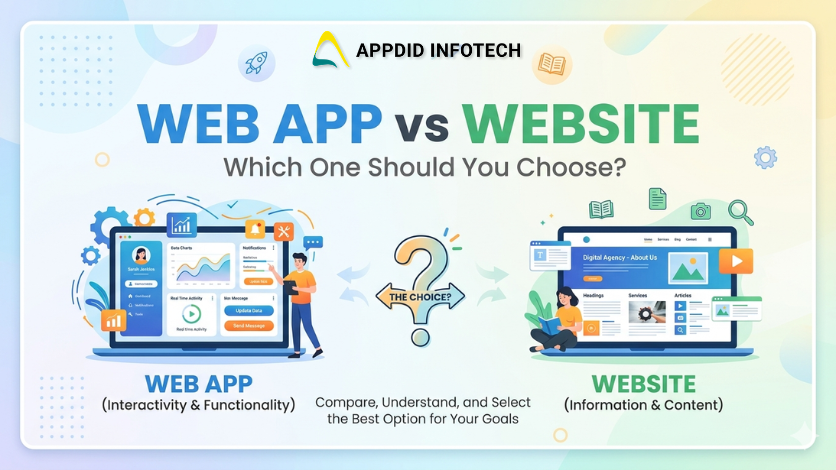
A website is a collection of interconnected web pages hosted on a server and accessible through a browser via a domain name. Websites are primarily informational in nature — they communicate who you are, what you do, and how people can reach you.
Common examples of websites include:
• Company or portfolio websites
• Blogs and news portals
• Landing pages and marketing sites
• E-commerce product catalogues
Websites are typically built using HTML, CSS, and sometimes basic JavaScript. They are easier to build, faster to launch, and more cost-effective for businesses that simply want an online presence without complex functionality.
What Is a Web App?
A web app (web application) is an interactive software program that runs in a web browser. Unlike a static website, a web app responds dynamically to user input and actions — processing data, managing accounts, generating outputs, and more.
Popular examples of web apps include:
• Gmail, Outlook (email platforms)
• Trello, Asana (project management tools)
• Canva, Figma (design tools)
• Shopify, Stripe dashboards (business platforms)
Web apps are more complex by nature. They typically require a back-end server, database, authentication system, and sometimes real-time data processing. Frameworks like React, Angular, Vue.js, and Node.js are commonly used to build them.
Web App vs Website: Key Differences at a Glance
Understanding the core differences between a web app and a website is the first step to making the right choice for your project.
1. Interactivity
Websites are largely static or semi-static. They display content, and users consume it. Web apps are highly interactive — users log in, submit forms, process payments, collaborate, and trigger real-time changes.
2. Authentication
Websites rarely require users to log in. Web apps almost always do. User accounts, permissions, roles, and sessions are central to how web apps function.
3. Complexity & Development Time
Websites are simpler to develop and can often be launched within days or a few weeks. Web apps require more planning, back-end architecture, API integration, and thorough testing — development timelines are significantly longer.
4. Cost
A professionally built website typically costs less than a web app. Web apps involve greater engineering complexity, server infrastructure, security layers, and ongoing maintenance — all of which add to the total cost.
5. Performance & SEO
Websites tend to be more SEO-friendly by default, since their content is static and easily crawlable by search engines like Google. Web apps require additional effort — such as server-side rendering (SSR) or static site generation (SSG) — to rank well organically.
When Should You Choose a Website?
Choose a website if:
• You want to establish an online presence for your brand or business
• Your goal is to share content, showcase a portfolio, or generate leads
• You need a fast, budget-friendly launch
• SEO and organic traffic are top priorities
• You don’t require complex user interaction or data processing
A polished, high-performing website is often the ideal starting point for new businesses looking to build credibility and attract customers online.
When Should You Choose a Web App?
Choose a web app if:
• You are building a SaaS product, marketplace, or digital platform
• Users need to create accounts and manage personalised data
• Your product involves real-time features like chat, notifications, or live collaboration
• You need to process transactions, bookings, or subscriptions
• Scalability and feature-rich functionality are core requirements
If your idea demands user accounts, data storage, and a dynamic experience — a web app is the way to go.
Can You Have Both?
Many successful digital products combine both. Think of Shopify — it has a marketing website (informational pages, blogs, landing pages) and a powerful web app (the merchant dashboard). This hybrid approach lets you leverage the SEO benefits of a website while delivering rich functionality through the app.
At Appdid, we specialise in building both — and helping you figure out which architecture is right for your goals before writing a single line of code.
Build Smarter with Appdid
Choosing between a web app vs website is not just a technical decision — it is a strategic one. The wrong choice can waste months of development time and thousands of dollars. The right choice, made early, sets the foundation for everything that follows.
At Appdid, we bring years of expertise in designing and developing both websites and web applications that are fast, scalable, and built for results. From concept to launch, we partner with startups and growing businesses to bring their digital vision to life — on time, within budget, and beyond expectations.
Ready to build? Visit www.appdid.com and let’s talk about your project today.
Frequently Asked Questions (FAQs)
Q1: What is the main difference between a web app vs website?
A website primarily displays static or semi-static content for users to read or browse. A web app is an interactive application that allows users to perform actions, manage data, log in, and interact with dynamic features in real time.
Q2: Is a web app more expensive than a website?
Generally, yes. Web apps require more complex development, including back-end infrastructure, databases, authentication, and ongoing maintenance. Websites are simpler, faster to build, and cost less upfront.
Q3: Can a web app rank on Google like a website?
Yes, but it requires additional effort. Web apps need techniques like server-side rendering (SSR), static site generation (SSG), or pre-rendering to ensure search engines can properly crawl and index their content. Without these, web apps may struggle with SEO compared to traditional websites.
Q4: Should a startup begin with a website or a web app?
It depends on your product. If you are validating an idea and need an online presence quickly, a website is the smart first step. If your core product IS the application (like a SaaS tool or marketplace), you will need a web app from the start. Many startups launch a marketing website first and build the app in parallel.
Q5: Can Appdid help build both a website and a web app?
Absolutely. Appdid has deep expertise in both. Whether you need a high-converting marketing website, a full-featured web application, or a hybrid solution — our team can design, develop, and deploy it to the highest standards.