
Java 21 Features Every Android Developer Should Know | JDK 21
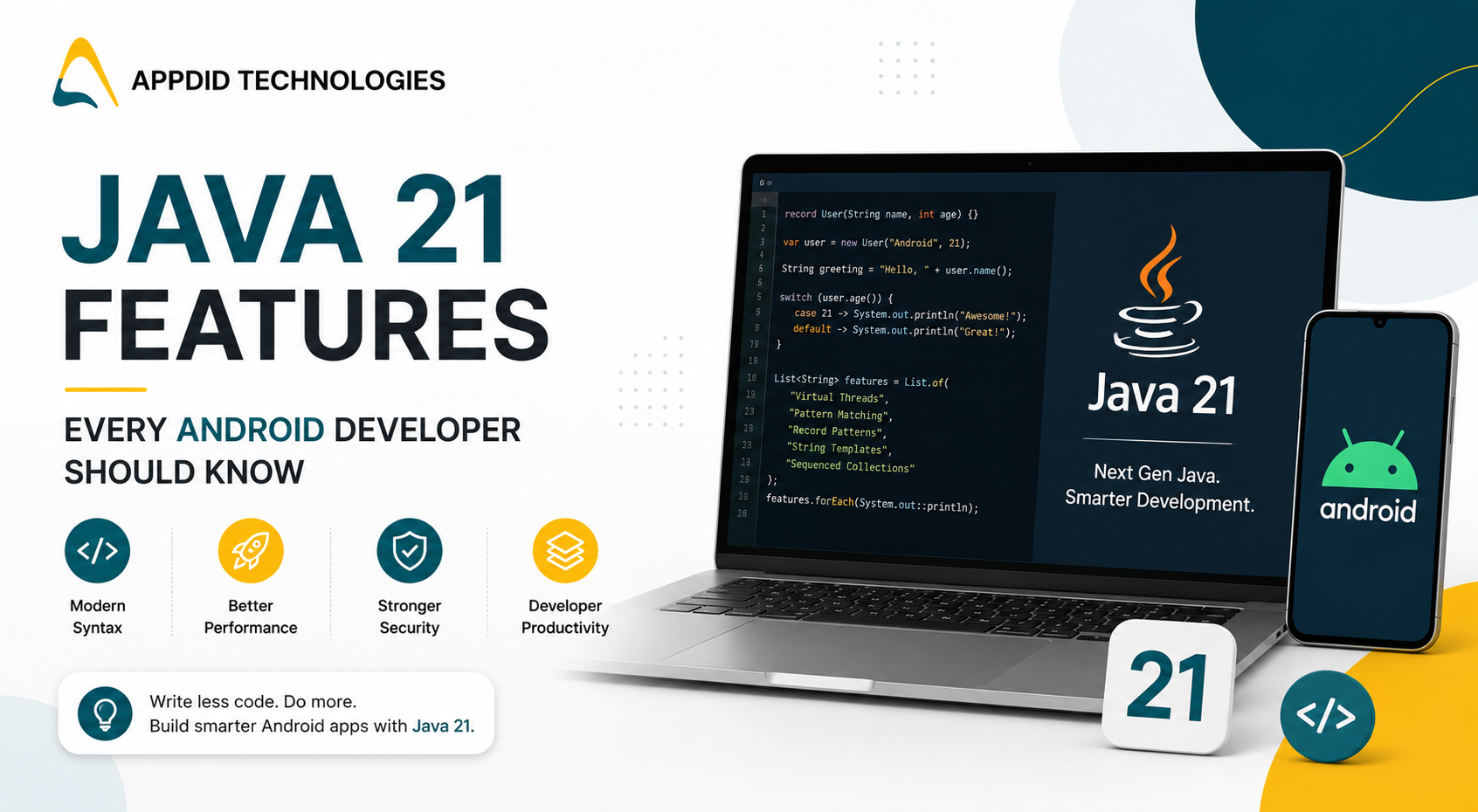
Java 21 Features Every Android Developer Should Know
Java continues to evolve with every Long-Term Support (LTS) release, introducing language enhancements that improve developer productivity, application performance, and code maintainability. Among these releases, Java 21 features have attracted significant attention because they provide modern programming capabilities while offering long-term stability.
For Android developers, understanding Java 21 features is valuable when building maintainable backend services, shared business logic, and Android applications using the latest compatible toolchains. While support for individual language features depends on your Android build environment and desugaring capabilities, adopting modern Java practices can significantly improve development efficiency.
Whether you're building enterprise software, backend services, or modern mobile applications, understanding Java 21 helps improve code quality and long-term maintainability. At Appdid, we leverage modern technologies to deliver scalable digital solutions through our Mobile App Development Services.
What Is Java 21?
Java 21 is the latest Long-Term Support (LTS) release from Oracle, providing years of stability, security updates, and performance improvements.
Compared to previous Java versions, Java 21 introduces cleaner syntax, improved concurrency, better memory management, and several developer-friendly language enhancements.
These improvements make Java an excellent choice for enterprise software, backend systems, APIs, and Android-related development workflows.
Why Java 21 Matters for Android Developers
Although Kotlin has become the preferred language for modern Android development, Java continues to play an important role across Android projects.
Developers still rely on Java for:
-
Existing Android applications
-
Enterprise Android projects
-
Backend APIs
-
Business logic
-
SDK development
-
Shared libraries
Learning Java 21 features helps developers write cleaner, safer, and more maintainable code.
Businesses investing in modern Android applications benefit from development teams that stay updated with the latest Java ecosystem. Learn more about our Android App Development Services in Mumbai, where we build secure, scalable, and high-performance Android applications.
Top Java 21 Features Every Android Developer Should Know
1. Virtual Threads
Virtual Threads are one of the biggest additions in Java 21.
They enable applications to create thousands of lightweight threads while consuming significantly fewer system resources than traditional platform threads.
Benefits include:
-
Better scalability
-
Improved server performance
-
Efficient background processing
-
Lower memory usage
Virtual Threads are especially useful for backend services powering Android applications.
2. Record Patterns
Record Patterns simplify extracting data from objects while reducing repetitive code.
Advantages include:
-
Cleaner syntax
-
Easier object handling
-
Improved readability
-
Less boilerplate code
Developers working with APIs and JSON responses will appreciate this improvement.
3. Pattern Matching for Switch
Pattern Matching enhances switch expressions by allowing developers to match object types directly.
Benefits include:
-
Cleaner business logic
-
Reduced nested conditions
-
Better readability
-
Easier maintenance
This feature simplifies complex decision-making code.
4. Sequenced Collections
Java 21 introduces Sequenced Collections, providing consistent APIs for accessing the first and last elements in collections.
Advantages include:
-
Better API consistency
-
Simplified collection management
-
Improved developer productivity
5. String Templates (Preview)
String Templates provide a more readable way to generate dynamic strings.
Potential use cases include:
-
API requests
-
Logging
-
Dynamic messages
-
SQL query generation
Since this is a preview feature, developers should evaluate production readiness before adoption.
6. Scoped Values
Scoped Values offer a safer alternative to ThreadLocal variables for sharing immutable data across concurrent operations.
Benefits include:
-
Better thread safety
-
Cleaner concurrency management
-
Improved application performance
7. Foreign Function & Memory API
This API allows Java applications to communicate with native libraries without relying heavily on JNI.
Advantages include:
-
Better interoperability
-
Higher performance
-
Simpler native integrations
8. Unnamed Classes & Instance Main Methods (Preview)
Java 21 reduces boilerplate for smaller applications by simplifying how developers write entry-point classes.
Although primarily intended for learning and experimentation, this feature reflects Java's ongoing focus on developer productivity.
9. Improved Garbage Collection
Java 21 further enhances G1, ZGC, and Shenandoah garbage collectors.
Benefits include:
-
Lower latency
-
Better responsiveness
-
Improved memory management
-
Higher throughput
Applications processing large workloads can experience more consistent performance.
10. Enhanced Security
Security improvements remain a major focus in Java 21.
Enhancements include:
-
Updated cryptographic algorithms
-
Better TLS support
-
Improved runtime security
-
Stronger secure coding practices
These updates help developers build safer enterprise and mobile applications.
Java 21 vs Previous Java Versions
| Feature | Java 17 | Java 21 |
|
Long-Term Support |
Yes | Yes |
| Virtual Threads | No | Yes |
| Record Patterns | Limited | Enhanced |
| Pattern Matching | Partial | Improved |
| Sequenced Collections | No | Yes |
| Performance | Excellent | Further Optimized |
| Concurrency | Traditional | Modernized |
Should Android Developers Upgrade to Java 21?
For new backend services and modern development projects, Java 21 offers significant advantages.
However, before upgrading, developers should verify compatibility with:
-
Android Studio
-
Android Gradle Plugin
-
D8/R8 desugaring
-
Third-party libraries
-
Build tools
Migrating should always be based on project requirements and ecosystem compatibility rather than simply adopting the newest version.
Organizations planning scalable Android applications can also explore our Mobile App Development in Mumbai services, where we help businesses choose technologies that support long-term scalability and performance.
Best Practices for Using Java 21
To make the most of Java 21:
-
Verify Android compatibility before upgrading.
-
Keep dependencies updated.
-
Test thoroughly before production deployment.
-
Use preview features carefully.
-
Follow clean coding principles.
-
Monitor application performance after migration.
Businesses looking to stay ahead of evolving technologies can also explore our guide on future-ready application development, covering modern mobile architectures, AI integration, cloud technologies, and scalable backend development.
Conclusion
The latest Java 21 features make Java more expressive, efficient, and developer-friendly than ever before.
From Virtual Threads and Pattern Matching to improved concurrency, memory management, and security, Java 21 provides valuable enhancements for Android developers building modern applications and enterprise software.
Understanding these features enables development teams to write cleaner code, improve application performance, and prepare projects for future technological advancements.
Appdid – Expert Mobile App Development Company
At Appdid, we develop Android, iOS, Flutter, React Native, and cross-platform applications using modern programming languages, scalable backend architectures, secure APIs, cloud technologies, and industry best practices.
Our development team continuously evaluates emerging technologies to build mobile applications that deliver high performance, security, and long-term maintainability.
You can also explore our Portfolio to see how we've delivered custom mobile applications and enterprise solutions across healthcare, logistics, education, retail, finance, and other industries.
If you're planning an Android application, enterprise mobility platform, or custom mobile solution, feel free to Contact Us. Our experts will help you choose the right technology stack and build a future-ready mobile application tailored to your business goals.
Frequently Asked Questions
What is Java 21?
Java 21 is the latest Long-Term Support (LTS) release that introduces modern language features, performance improvements, better concurrency, and enhanced security.
Is Java 21 good for Android development?
Yes. Java 21 offers several language improvements, although feature availability depends on your Android toolchain, Gradle version, desugaring support, and project compatibility.
What are the most important Java 21 features?
Key Java 21 features include Virtual Threads, Record Patterns, Pattern Matching for Switch, Sequenced Collections, Scoped Values, Foreign Function & Memory API, and improved garbage collection.
Should Android developers migrate to Java 21?
Developers should evaluate compatibility with Android Studio, Gradle, libraries, and project requirements before migrating to Java 21.
How does Appdid build modern Android applications?
Appdid develops Android applications using modern programming languages, scalable architectures, secure APIs, cloud-native technologies, and development best practices to deliver high-performance mobile applications.