
How to Choose the Right Tech Stack for Custom App Development
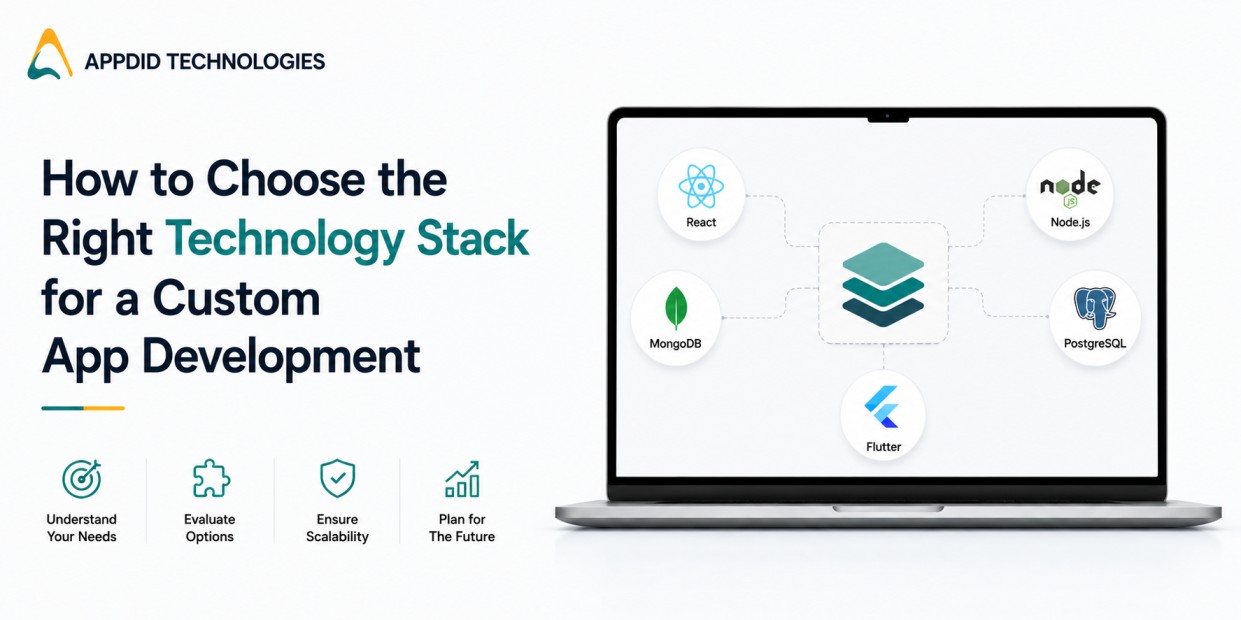
How to Choose the Right Technology Stack for a Custom App Development
Choosing a tech stack is one of the earliest and most important decisions in custom app development. The technologies selected for the frontend, backend, database, APIs, cloud infrastructure, and development tools can directly affect an application's performance, scalability, security, maintenance, and future development.
There is no single technology stack that works best for every mobile application. A simple content-based app may have very different requirements from a healthcare platform, eCommerce application, or enterprise solution.
So, instead of choosing technologies because they are popular, businesses should select a tech stack based on what the application actually needs.
What Is a Tech Stack?
A tech stack is the combination of programming languages, frameworks, databases, development tools, and infrastructure used to build and operate an application.
For a mobile application, a typical technology stack may include:
-
Mobile frontend technology
-
Backend programming language and framework
-
Database
-
APIs
-
Cloud infrastructure
-
Authentication and security tools
-
Third-party integrations
-
Testing and monitoring tools
For example, an application could use Kotlin for Android development, Swift for iOS, Node.js or another backend technology for server-side development, and PostgreSQL or MongoDB for data storage.
The exact combination depends on the application's requirements.
Why Does the Technology Stack Matter?
The technology stack isn't just a technical choice. It can influence how the product performs and evolves over time.
A suitable stack can help with:
-
Application performance
-
Development efficiency
-
Scalability
-
Security
-
Maintenance
-
Third-party integrations
-
Future feature development
-
Infrastructure costs
Choosing an unsuitable technology can create problems later. For example, a framework may work well for a small application but become difficult to maintain when the product grows in complexity.
This is why technology selection should happen after understanding the product rather than before it.
Key Factors to Consider When Choosing a Tech Stack
1. Type of Application
Start by understanding what you're building.
A business application, marketplace, social platform, healthcare app, banking application, or logistics platform may require completely different technical considerations.
For example, an eCommerce application may require payment integration, product catalogs, order management, real-time notifications, and inventory synchronization. You can see how these requirements influence development in our guide to eCommerce app development.
2. Target Platform
The choice between Android, iOS, or both platforms affects the technology stack.
For Android applications, Kotlin is a major choice for modern native development. For iOS, Swift is commonly used.
Businesses that want platform-specific applications can consider Android app development and iOS app development based on their audience and requirements.
If the application needs to support both platforms while sharing a significant portion of the codebase, cross-platform development may be worth evaluating.
Our guide to native vs cross-platform app development explains the differences and trade-offs.
3. Native vs Cross-Platform Technology
This is one of the most common decisions in mobile app development.
Native Development
Native applications are built specifically for a particular operating system.
Common choices include:
-
Kotlin for Android
-
Swift for iOS
Native development can be useful when an application requires extensive platform-specific functionality, advanced performance, or deep integration with device capabilities.
Cross-Platform Development
Cross-platform frameworks allow developers to build applications for multiple platforms from a shared codebase.
Flutter and React Native are commonly considered for this approach.
Cross-platform development can reduce duplicated development work and make maintaining multiple platforms easier in certain projects.
However, the decision should depend on the application's functionality, performance requirements, team expertise, and long-term roadmap.
4. Backend Technology
The backend is responsible for handling application logic, authentication, APIs, data processing, integrations, and communication with databases.
Popular backend technologies include:
-
Node.js
-
Python
-
Java
-
PHP
-
.NET
The best choice depends on the complexity of the application and the expertise required.
For example, a system with extensive business logic and enterprise integrations may have different backend requirements from a relatively simple mobile application.
5. Database Selection
The database should match the way your application stores and retrieves information.
Common options include:
-
PostgreSQL
-
MySQL
-
MongoDB
-
Firebase
-
Microsoft SQL Server
SQL databases can be useful when applications require structured data and strong relationships between entities.
NoSQL databases can be useful for applications requiring flexible data structures and particular scalability patterns.
The decision shouldn't be based purely on whether SQL or NoSQL is more popular. Data structure, queries, consistency requirements, scalability, and application architecture should all be considered.
6. API Architecture
Most modern mobile applications communicate with backend systems through APIs.
REST APIs remain widely used, while GraphQL can be useful when applications need more flexible data querying.
API architecture should be planned around:
-
Data requirements
-
Security
-
Performance
-
Integration requirements
-
Versioning
-
Scalability
Businesses can learn more about this area in our guide to API integration in mobile app development.
7. Cloud Infrastructure
Cloud infrastructure can provide the flexibility needed to scale applications as usage increases.
Depending on the project, businesses may consider services from providers such as AWS, Microsoft Azure, or Google Cloud.
Cloud architecture can support:
-
Application hosting
-
Databases
-
File storage
-
Authentication
-
APIs
-
Monitoring
-
Automated deployments
However, cloud adoption should also be planned carefully. Selecting services without considering actual requirements can increase complexity and operational costs.
You can also explore our article on the benefits of cloud integration for more context.
8. Security Requirements
Security should influence technology choices from the beginning.
The tech stack should support appropriate measures for:
-
Authentication
-
Authorization
-
Encryption
-
Secure API communication
-
Data protection
-
Session management
-
Logging and monitoring
Applications handling financial, healthcare, personal, or business-critical information may require additional security considerations.
The technology stack should therefore be evaluated not only for development speed but also for how effectively it can support the application's security requirements.
9. Scalability
Think beyond the first version of the application.
If an application starts with 5,000 users but is eventually expected to serve millions, the architecture should be capable of evolving with that growth.
Scalability can involve:
-
Database architecture
-
Backend design
-
Cloud infrastructure
-
Caching
-
API architecture
-
Load balancing
-
Storage
A scalable tech stack doesn't mean building an unnecessarily complex system from day one. It means making sensible architectural decisions that won't restrict future growth.
10. Development Team Expertise
Technology should also be selected based on whether developers can work effectively with it.
A theoretically excellent framework may not be the best choice if finding experienced developers for it is difficult.
Consider:
-
Developer availability
-
Existing technical expertise
-
Community support
-
Documentation
-
Long-term ecosystem health
-
Maintenance requirements
A strong development team can often recommend alternatives based on the project's specific requirements.
Common Technology Stack Combinations
There are many possible combinations, but some common approaches include:
|
Application Layer |
Common Technologies |
|
Android |
Kotlin, Android SDK |
|
iOS |
Swift, SwiftUI, UIKit |
|
Cross-platform |
Flutter, React Native |
|
Backend |
Node.js, Java, Python, PHP, .NET |
|
Relational Database |
PostgreSQL, MySQL |
|
NoSQL Database |
MongoDB, Firebase |
|
API |
REST, GraphQL |
|
Cloud |
AWS, Azure, Google Cloud |
|
Version Control |
Git, GitHub, GitLab |
These are examples rather than a fixed formula. The right stack depends on the project's functional and technical requirements.
How to Choose a Tech Stack Step by Step
Instead of starting with a programming language, follow a requirement-first approach.
Step 1: Define the Product Requirements
List the application's core functionality, users, platforms, integrations, and expected usage.
Step 2: Identify Technical Requirements
Determine requirements related to performance, security, scalability, offline functionality, real-time communication, and data processing.
Step 3: Select the Application Architecture
Decide how the frontend, backend, database, APIs, and external services will communicate.
Step 4: Compare Technologies
Evaluate potential technologies based on performance, ecosystem, development resources, maintenance, and long-term viability.
Step 5: Build and Test
Start development with the selected architecture and continuously test performance, security, and usability.
Step 6: Review Before Scaling
As the application grows, monitor its performance and infrastructure to identify areas that need optimization.
Tech Stack for Different Types of Apps
The right technology can vary significantly depending on the industry.
For example, a healthcare application may prioritize security, privacy, integrations, and reliable data handling. Our healthcare app development work involves these kinds of considerations.
A CRM platform may instead focus heavily on database architecture, APIs, dashboards, automation, and integrations. Businesses exploring this type of product can look at CRM software development as an example of a more data-intensive application environment.
Similarly, a service marketplace may require location services, real-time notifications, booking workflows, and payment integrations.
This demonstrates why there is no universally "best" tech stack.
Common Mistakes When Choosing a Tech Stack
Choosing Based Only on Popularity
A technology being popular doesn't automatically make it suitable for your application.
Prioritizing Development Speed Over Architecture
Fast development is useful, but shortcuts that create architectural problems can become expensive later.
Ignoring Maintenance
Consider who will maintain the application, update dependencies, fix bugs, and introduce new features after launch.
Overengineering
Not every application requires microservices, multiple databases, or complex cloud infrastructure.
Start with what the product needs and build the architecture to evolve.
Ignoring Future Requirements
A stack should support the foreseeable roadmap rather than only the first release.
How Appdid Approaches Technology Selection
At Appdid, technology selection starts with understanding the application rather than choosing a predetermined stack for every project.
Depending on the requirements, our development teams work with native and cross-platform technologies, backend frameworks, databases, APIs, cloud infrastructure, and third-party services.
For businesses exploring their development options, our mobile app development services cover different application types and technical requirements.
The technology stack is then selected according to factors such as functionality, target platforms, scalability, integrations, performance, security, and long-term maintenance.
You can also explore our portfolio to see examples of the types of digital products and applications we work on.
Final Thoughts
Choosing the right tech stack isn't about finding the newest programming language or the most popular framework.
It is about finding the combination of technologies that best fits the application's users, functionality, performance requirements, security needs, budget, development team, and long-term roadmap.
For a simple application, a relatively straightforward stack may be the best option. For a complex platform, a more structured architecture may be necessary.
The most important principle is simple: choose technology based on the product, not the trend.
Appdid – Custom App Development
Appdid is a mobile app and software development company helping businesses turn application ideas into scalable digital products.
Our teams work across mobile app development, backend systems, APIs, cloud technologies, databases, and custom software solutions. We select technologies based on project requirements rather than following a single technology stack for every application.
Businesses can explore Appdid's technology and development services to understand the different solutions we provide.
If you're evaluating the right technology approach for your next application, you can contact Appdid to discuss your requirements.
Frequently Asked Questions
What is a tech stack in app development?
A tech stack is the collection of technologies used to build and operate an application, including programming languages, frameworks, databases, APIs, cloud infrastructure, and development tools.
How do I choose the right tech stack for an app?
Start with the application's requirements, target platforms, expected users, functionality, security needs, integrations, scalability requirements, and available development expertise. Then compare technologies against those requirements.
Is native or cross-platform development better?
Neither is universally better. Native development can be useful for platform-specific functionality and performance, while cross-platform development can be useful when supporting multiple platforms with shared code is a priority.
Which database is best for mobile applications?
There is no single best database. SQL and NoSQL databases have different strengths, and the choice should depend on the application's data structure, queries, scalability, and consistency requirements.
Can the technology stack be changed after development starts?
Yes, but changing core technologies after significant development can be costly and disruptive. This is why architecture and technology choices should be evaluated carefully before development begins.
Does Appdid use one fixed technology stack?
No. The technology stack can vary depending on the application's requirements, platform, functionality, integrations, performance expectations, and scalability needs.