
RAG vs Fine-Tuning: Best AI App Strategy Guide
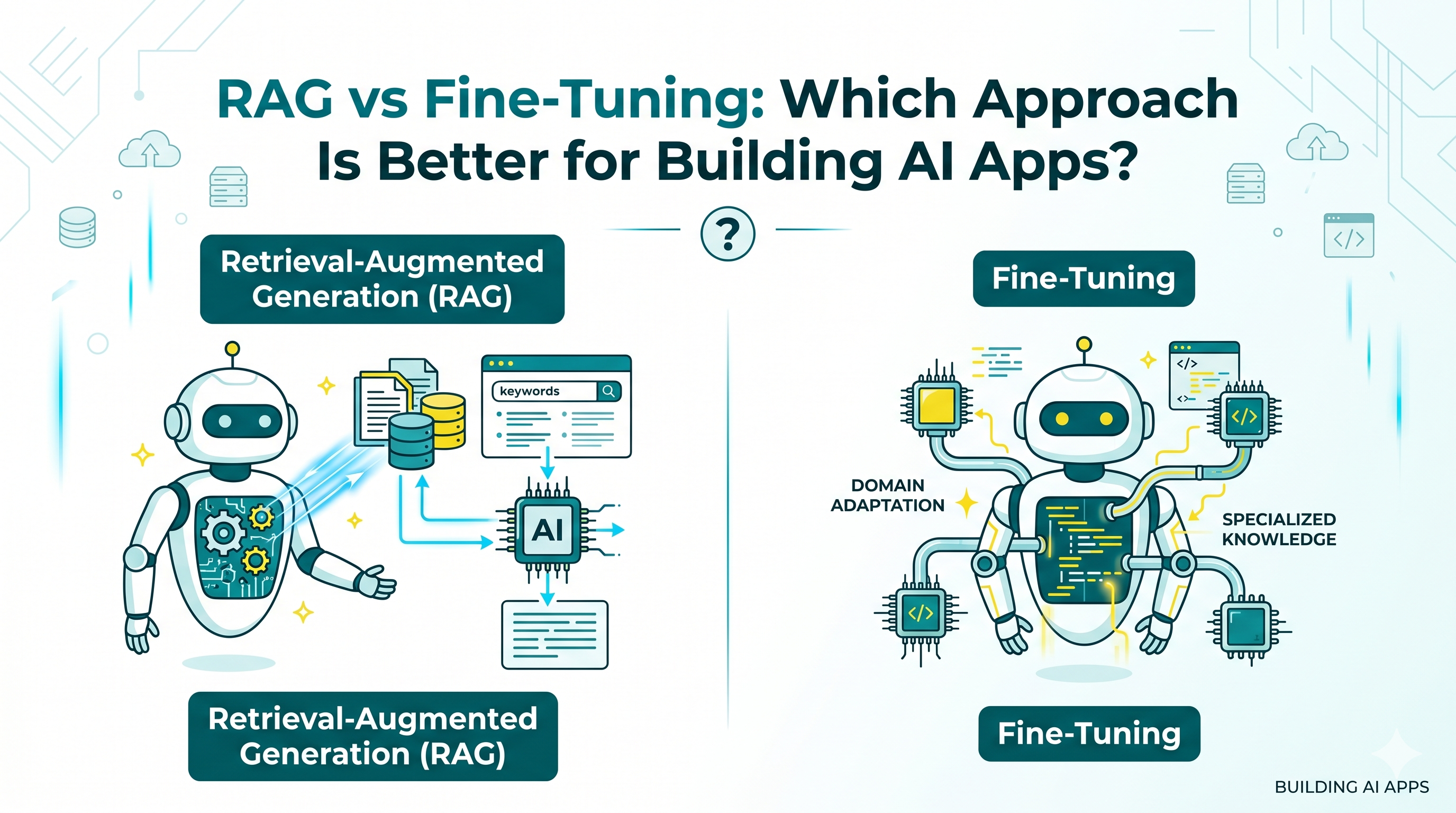
RAG vs Fine-Tuning: Which Approach Is Better for Building AI App
Quick Summary
When building AI-powered applications, choosing between Retrieval-Augmented Generation (RAG) and Fine-Tuning can significantly impact performance, cost, and scalability. RAG is ideal for dynamic, real-time data access, while Fine-Tuning excels at creating highly specialized and consistent models. This blog explores the differences, advantages, and best use cases of both approaches to help you decide which is better for your AI app development strategy.
Introduction
As AI applications continue to evolve, developers and businesses face a critical decision: RAG vs Fine-Tuning. Both methods enhance large language models (LLMs), but they serve different purposes depending on your project needs.
Understanding these two approaches is essential for building scalable, accurate, and cost-efficient AI systems. Whether you're developing a chatbot, automation tool, or enterprise AI platform, your choice can directly influence user experience and operational costs.
What is Retrieval-Augmented Generation (RAG)?
Retrieval-Augmented Generation (RAG) is a technique that combines a language model with an external knowledge source. Instead of relying only on pre-trained data, RAG retrieves relevant information from databases, documents, or APIs in real time and uses that context to generate responses.
This makes RAG especially powerful in environments where information changes frequently or needs to be highly accurate.
Key Benefits of RAG:
-
Access to up-to-date information
-
No need for retraining the model
-
Lower cost compared to fine-tuning
-
Improved factual accuracy
-
Easy scalability by expanding data sources
Best Use Cases:
-
Chatbots with real-time data
-
Knowledge base assistants
-
Customer support automation
-
Enterprise search systems
-
AI tools connected to live APIs
What is Fine-Tuning?
Fine-Tuning involves training a pre-trained model on a specific dataset to make it more specialized. This process adjusts the model’s internal parameters so that it better understands a particular domain, tone, or style.
Unlike RAG, Fine-Tuning embeds knowledge directly into the model rather than retrieving it externally.
Key Benefits of Fine-Tuning:
-
Highly customized responses
-
Better tone, style, and domain alignment
-
Reduced dependency on external data sources
-
Consistent output quality
-
Faster response time at runtime
Best Use Cases:
-
Industry-specific applications (healthcare, finance, legal)
-
Brand-specific conversational AI
-
Content generation tools
-
Sentiment analysis and classification tasks
-
AI assistants requiring consistent tone
RAG vs Fine-Tuning: Key Differences
|
Feature |
RAG |
Fine-Tuning |
|
Data Source |
External retrieval |
Internal training |
|
Cost |
Lower |
Higher |
|
Scalability |
High |
Moderate |
|
Real-Time Updates |
Yes |
No |
|
Customization |
Moderate |
High |
|
Maintenance |
Easier |
Requires retraining |
Real-World Comparison
Data Freshness vs Consistency
RAG is ideal for applications that rely on constantly updated information. For instance, news aggregators, stock market platforms, or travel apps need real-time data to remain accurate and relevant. By retrieving information dynamically, RAG ensures users always receive the latest updates.
In contrast, Fine-Tuning is better suited for scenarios where consistency and reliability are more important than frequent updates. Applications such as legal assistants, medical tools, or compliance systems benefit from a stable and controlled knowledge base, where accuracy and consistency are critical.
Performance and Latency
RAG involves an additional step of retrieving relevant data before generating a response. This process can introduce slight latency, especially when dealing with large datasets or complex queries.
Fine-Tuning, however, eliminates the need for real-time retrieval. Since the knowledge is already embedded within the model, responses are typically faster. This makes Fine-Tuning a strong choice for applications where speed and responsiveness are essential.
Data Privacy and Security
RAG systems often rely on external databases or APIs, which can pose potential risks when handling sensitive information. Ensuring secure data access and proper handling becomes crucial in such cases.
Fine-Tuning offers better control over data since the knowledge is stored within the model itself. This makes it a preferred approach for industries with strict privacy and compliance requirements, such as healthcare, finance, and legal sectors.
Scalability
RAG systems are highly scalable because you can expand their knowledge simply by adding or updating data sources. There is no need to retrain the model, making it easier to manage growing datasets.
Fine-Tuning, on the other hand, requires retraining whenever new information needs to be incorporated. This can increase both time and cost, making scalability more challenging compared to RAG.
When to Use a Hybrid Approach
In many modern AI systems, combining RAG and Fine-Tuning provides the best results. Instead of choosing one over the other, developers integrate both to leverage their strengths.
How Hybrid Systems Work:
-
Fine-Tuning is used to define tone, behavior, and domain expertise
-
RAG is used to inject real-time and external knowledge
Benefits of Hybrid Approach:
-
Improved accuracy and relevance
-
Real-time adaptability
-
Consistent brand voice
-
Better user experience
For example, an AI customer support system can use Fine-Tuning to maintain a brand’s tone while using RAG to fetch the latest product or policy information.
Cost Considerations
RAG Costs:
-
Embedding generation
-
Vector database storage
-
Retrieval queries
RAG typically has lower upfront costs and follows a pay-as-you-scale model, making it suitable for startups and growing businesses.
Fine-Tuning Costs:
-
Model training
-
Dataset preparation
-
Infrastructure and compute resources
Fine-Tuning requires a higher initial investment but can reduce costs per query in the long run, especially for high-volume applications.
Common Mistakes to Avoid
1. Choosing Fine-Tuning Too Early
Many teams assume Fine-Tuning is necessary from the start. In reality, RAG can solve many problems more efficiently without the added complexity.
2. Poor Data Quality in RAG
RAG is only as effective as the data it retrieves. If your knowledge base is outdated or unstructured, the output quality will suffer.
3. Ignoring Performance Metrics
Failing to track metrics such as accuracy, latency, and cost can lead to inefficient systems. Regular evaluation is essential for optimization.
Which Approach Is Better for Building AI Apps?
The answer depends entirely on your requirements.
Choose RAG if:
-
Your application requires real-time or frequently updated data
-
You want a cost-effective and scalable solution
-
Your data changes frequently
Choose Fine-Tuning if:
-
You need highly specialized outputs
-
Your use case requires consistent tone or branding
-
You are working with domain-specific or sensitive data
Choose Hybrid if:
-
You want both real-time data and customization
-
You are building a production-level AI system
-
You aim for long-term scalability and performance
Conclusion
Both RAG and Fine-Tuning offer powerful ways to enhance AI applications. RAG excels in dynamic, data-driven environments where real-time information is critical, while Fine-Tuning provides deep customization and consistency for specialized use cases.
If you're deciding between RAG vs Fine-Tuning, focus on your data requirements, budget, and scalability goals. In many cases, a hybrid approach delivers the most balanced and effective solution.
By understanding the strengths and limitations of each method, you can build smarter, more efficient AI applications that meet modern user expectations.
FAQs
1. What is the main difference between RAG and Fine-Tuning?
RAG retrieves external data in real time, while Fine-Tuning modifies the model using a custom dataset.
2. Is RAG cheaper than Fine-Tuning?
Yes, RAG is generally more cost-effective since it avoids retraining the model.
3. Can RAG and Fine-Tuning be used together?
Yes, combining both approaches often delivers the best results.
4. Which is better for real-time applications?
RAG is better suited due to its ability to fetch live data.
5. Does Fine-Tuning improve accuracy?
Yes, especially for domain-specific tasks requiring tailored responses.
6. Is Fine-Tuning suitable for small businesses?
It depends on budget and use case, but RAG is usually a better starting point.
7. How do I choose between RAG and Fine-Tuning?
Evaluate your need for real-time data, customization, and available resources.
Build Smarter AI Apps with Experts
Looking to implement the right AI strategy for your business? Whether it's RAG, Fine-Tuning, or a hybrid solution, expert guidance can make all the difference.
Appdid – Best App Development Company in Mumbai
Get in touch today to build scalable, intelligent, and future-ready AI applications tailored to your business needs.